Vox Africanorum
"Vox Africanorum" and The Paradox of American Liberty after the Revolutionary War
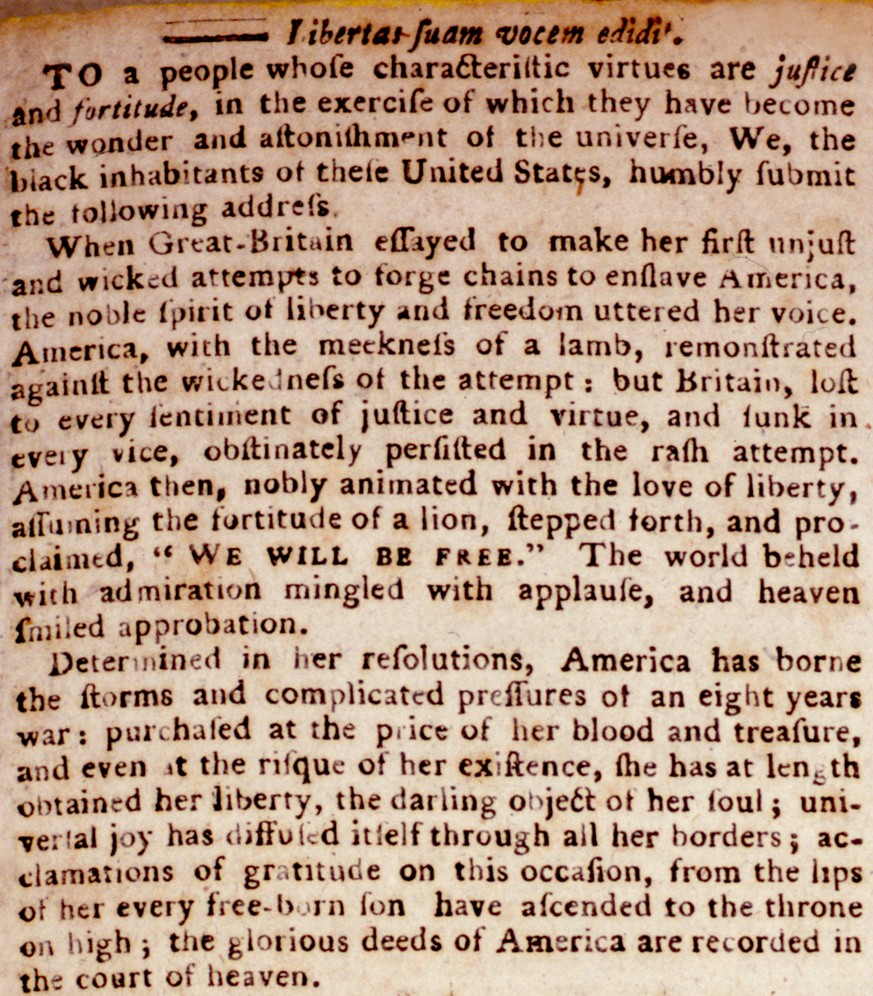
Maryland Gazette, 15 May 1783. Collection of the Maryland State Archives [MSA SC 2311-1-18]
Maryland relied on chattel slavery while the Patriots boldly declared that "all men [were] created equal." By the time the American Revolution came to a close, a new iteration of the paradox of American liberty emerged. How could a war for independence be fought under a banner of "enlightened" ideals — liberty and freedom — while thousands of humans remained enslaved in the United States?
On May 15, 1783, "Vox Africanorum" exposed this contradiction in a searing editorial published in the Maryland Gazette. The result is a resounding and enduring example of "transcendent liberty."
Presumably written by one or more Black Marylanders under the pseudonym, "Vox Africanorum," the self-titled piece proclaimed to collectively represent "the black inhabitants of these United States." Yet, the author(s) made a strategic decision to begin the letter by riding the crest of the Revolutionary wave.
Early portions of the column-length piece powerfully and unreservedly support the cause of American independence from Great Britain. And it did so using the same rhetoric of slavery that colonists wielded to assail the British Empire; "Vox Africanorum" exploited this rhetoric of slavery:
"When Great-Britain essayed to make her first unjust and wicked attempts to forge chains
to enslave America, America then, nobly animated with the love of liberty... proclaimed, 'We Will be Free.'"
"Vox Africanorum" contended that Black Americans are as entitled to the same liberties enshrined in the Declaration of Independence as their white compatriots. The author(s) challenged Americans to "Attend to your own declarations — 'These truths are self-evident—all men are created equal; they are endowed by their creator with certain unalienable rights; among these are life, liberty, and the pursuit of happiness.' We shall offer no arguments... It would be to suppose she has already forgot those exalted principles she has so lately asserted with her blood."
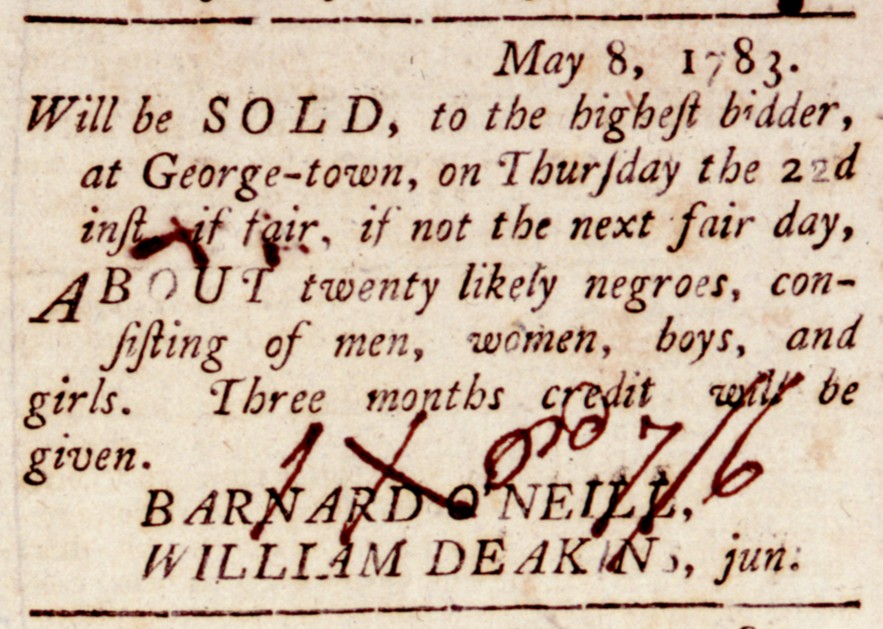
Maryland Gazette, 15 May 1783. Collection of the Maryland State Archives [MSA SC 2311-1-18]
While Vox Africanorum's ardent plea for equality and liberty in the new Republic consumed nearly an entire column on the page, the cruelties of slavery continued. The same page of the Maryland Gazette that included "Vox Africanorum" featured four advertisements promoting, perpetuating, and participating in chattel slavery: one slave trader's sale, one fugitive slave advertisement, one jail committal notice of a runaway, and one estate sale of enslaved people [image left]. Placing "Vox Africanorum" in its printed context starkly reveals the paradox of American liberty.
To learn more about the context surrounding "Vox Africanorum," see "Paradox in Print: 'Vox Africanorum,' Slavery, and Page Three of the Maryland Gazette."
Among those to whom the authors directed their plea were the members of the Maryland General Assembly. While "Vox Africanorum" prepared for publication, legislation aimed at restricting the rights of free Black Marylanders moved through the recently completed State House. On June 1, 1783 - just over two weeks after the publication of "Vox Africanorum" - the Maryland General Assembly barred manumitted Black Marylanders from voting. An amendment to the state constitution in 1803 restricted the vote to white men only, further limiting Black life in Maryland.
For more information connecting "Vox Africanorum" with Maryland's early history of voting rights, see "Paradox at the Polls: 'Vox Africanorum' and Black Voting in Early Maryland."
"Vox Africanorum" deserves a place among the canon of landmark documents in American history. Strands of the struggle faced by Black Americans in the 1780s persist into the twenty-first century as the United States continues its quest to "form a more perfect union." "Vox Africanorum" reminded Americans in 1783, and reminds the world today, that the struggle for full liberty continues.