Black Military Service
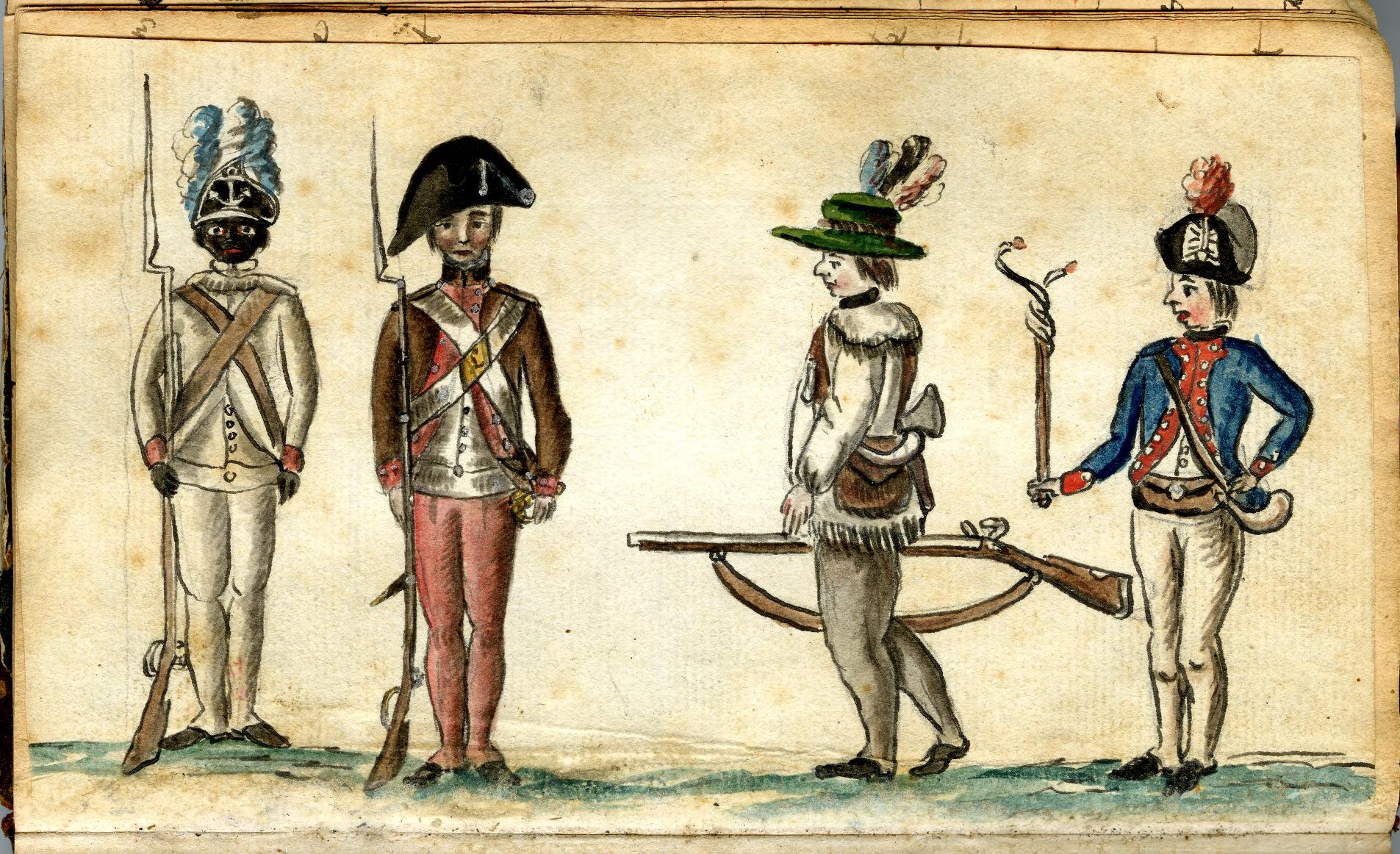
Depiction of a soldier in the all-Black First Rhode Island
Regiment. Jean Baptiste Antoine De Verger, 1781.
Library of Congress
Black Soldiers During the Revolutionary War
From the very beginning of the American Revolutionary War (1775-1783), Black and Indigenous people played a role in the fight for independence. Crispus Attucks, who was of Black and Indigenous heritage, was killed at the Boston Massacre (1770) and is often considered the first casualty of the Revolution. Black men from every state fought during the war. These soldiers included both people born free and men who had formerly been enslaved and manumitted. Others could have enlisted while enslaved, but their service did not guarantee their freedom. About 5,000 Black soldiers fought in the Continental Army as did a smaller number of Indigenous people. On average, Black troops served longer than white soldiers, and a higher percentage of eligible Black men served than white men.
The Continental Army only tabulated Black soldiers once, in 1778. At that time there were 775 Blacks in the army, about 3 percent of its total strength. This number understates the true extent of Black participation, as some men served before or after that time. Others served in local militia units rather than the regular army. In some cases, Blacks were limited to non-combat positions as servants, teamsters, or laborers. For the most part, however, they served and fought alongside white troops in regular infantry units. There was one all-Black unit, the First Rhode Island Regiment, formed in 1778. Otherwise, the Continental Army was fully integrated. The American army would not be integrated again until 1948.
There were no Black officers. The vast majority of Blacks in the army were ordinary privates, while a few were fifers or drummers. A few Black soldiers served as corporals during the war, the lowest non-commissioned officer's rank. While not common, this represented an instance of a Black person holding a measure of authority over whites, a rare occurrence in eighteenth century America.
"I wish the [Black] regiment would be raised. I am of the opinion that the Blacks will make excellent soldiers—
indeed experience proves it [...] As to the danger of training them to Arms—tis the Child of a distempered
Imagination. There are some people who are forever frightening themselves [...]"Major Edward Giles (1759-1783) of Maryland, Continental Army, 1781

Men who served in the Maryland Line were issued uniforms which
included a blue regimental coat with red trim, hat, cartridge
box, and knapsack as well as a musket and bayonet.
T. Payton/National Park Service
The Maryland Experience
More than 150 Black soldiers served in Maryland militia units and the Continental Army. The true number is difficult to determine since Black soldiers' race was generally not noted in enlistment records. To date, Maryland State Archives researchers have documented roughly 90 Black soldiers who served during the war.
Maryland's leaders were initially reluctant to accept Black soldiers, fearing that it would encourage uprisings by enslaved people. It is likely that the first contingent of soldiers raised in 1776 was all white. However, by the summer of 1776, Maryland began enlisting Black men, and every infantry unit was integrated for the remainder of the war. There was a proposal to form an all-Black regiment in Maryland but it never happened.
Maryland was the only southern state that enlisted enslaved people, who could serve as substitutes for white men beginning 1778. Enslaved individuals could also enlist on their own beginning in 1780, but serving in the Continental Army did not guarantee their freedom.
When the Continental Army compiled information about the number of Black soldiers in its ranks in 1778, the Maryland Line included 95 men, about 2.7 percent. That total only accounts for the men serving in 1778, not including those in the army before or after 1778, nor those in the state militia.
The names below are the Black and Indigenous men identified who served, were called to serve, or attempted to enlist in Maryland's Continental Army units or the state's militia. In some cases, the details of their service are not certain.
List of Black and Indigenous Soldiers in Maryland's Continental Army and Militia (opens as a PDF)
Proof of Marriage
Collection of the Maryland State Archives [MSA S 1000-2].
Read transcript here.
Women of the Army and Others Supporting the Army
Like their white counterparts, Black soldiers were sometimes accompanied by their wives and families. These women cooked for the troops, washed laundry, sold supplies, and provided unofficial logistical support for the army. Historians estimate their numbers to have been in the thousands. In addition, Maryland's white officers sometimes brought their enslaved servants.
Few Black camp followers have been identified, and little is known about their lives. However, in some instances, a few details have been discovered. One such woman is a Black woman named Jane Russell.
Although married women were permitted to travel with the army, commanders did not want single women in camp. This proof of marriage [image left] was drawn up on April 2, 1779, likely intended to allow Jane to remain in camp as a widow. She could have hoped to remain with the army in order to support herself by cooking, repairing uniforms, or washing laundry. Jane, Henry Russell, and Barton Swan are now definitively recorded as people of color who valiantly served on behalf of American independence.
The list below shows the names of Black or Indigenous individuals connected with Maryland's military but were not soldiers themselves. Some were free camp followers like Jane Russell, while others were enslaved.
List of Women and Others Supporting the Army (opens as a PDF)Do you have information about a Black Patriot you'd like to share? Email us at msa.helpdesk@maryland.gov