The Pursuit of Transcendent Liberty
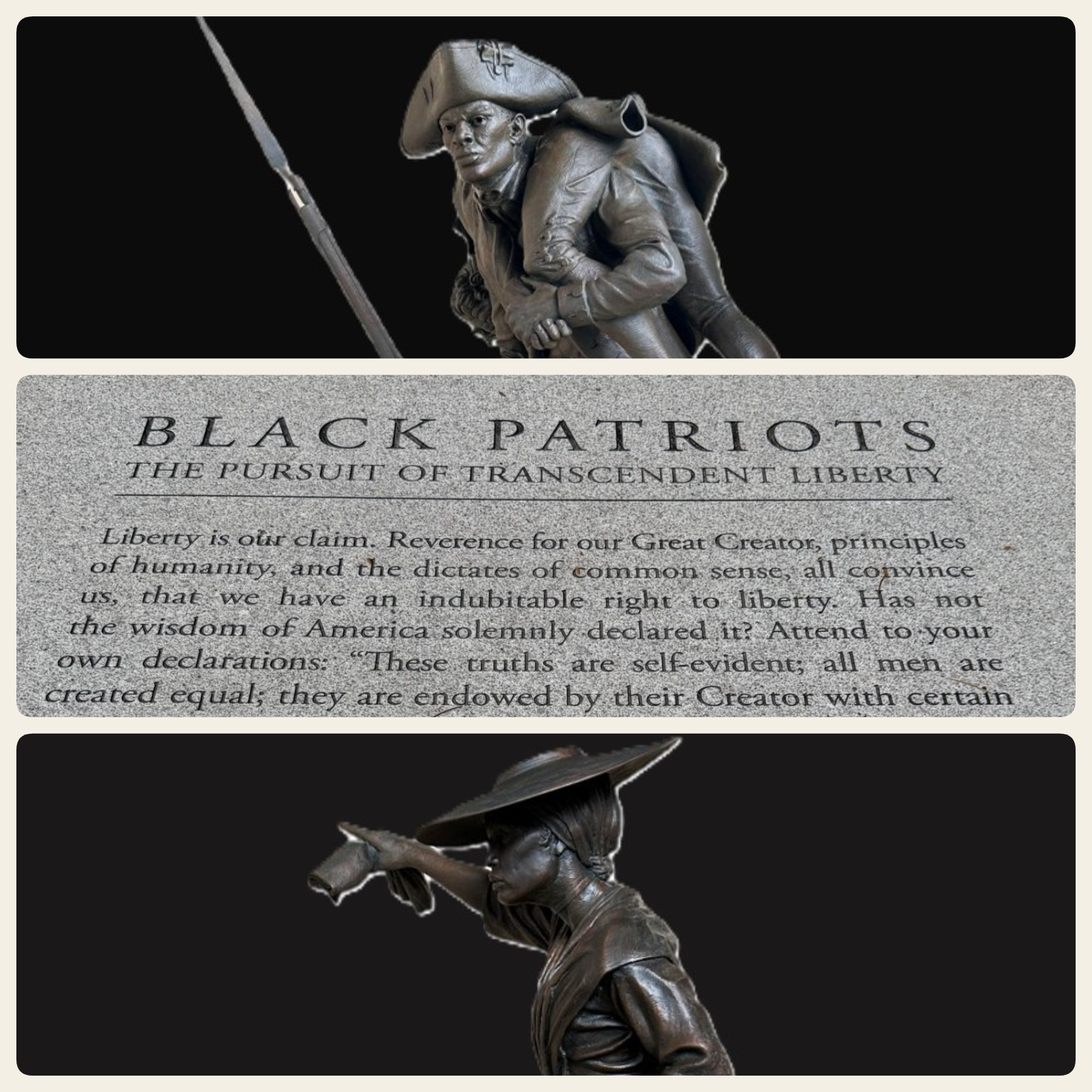
Title: The Pursuit of Transcendent Liberty
Artist: Branly Cadet (b.1964)
Medium: Bronze & granite
Year: 2026
Collection of the Maryland State Archives
Two hundred fifty years before this monument's unveiling, a group of white American men declared to the world their universal right to "life, liberty, and the pursuit of happiness." Since then, Black men and women have been at the forefront of movements urging the United States of America to live up to its revolutionary ideals - to make them truly transcendent.
The monument's location is significant. Standing tall on the front lawn of the Maryland State House, the statues are placed at the historic entrance to a government building where slavery was both entrenched in the eighteenth century and abolished in 1864; and they overlook a city that derived much of its wealth from the slave trade but also possesses a storied history of Black prosperity in the face of discrimination. To date, this is the only monument on the grounds of any state capital dedicated to Black Revolutionary War soldiers.
Of the services and sufferings of the colored soldiers of the Revolution,
no attempt has, to our knowledge, been made to preserve a record.
Their history is not written; it lies upon the soil watered with their blood: who shall gather it?William Howard Day (c. 1825-1900), Black abolitionist, publisher, and teacher from New York, 1852
The Pursuit of Transcendent Liberty commemorates the role of the African American community in Revolutionary Maryland. Over 150 Black Marylanders, the majority of whom were free, although some had been enslaved, are known to have enlisted and served in the Continental Army and state militia during the American Revolutionary War (1775-1783). Their existence and contributions have been largely unacknowledged in Maryland's public history.
Black Patriots traveled with an integrated army that included free and enslaved women and children who were integral to its operation. Their contributions in providing the foundation and support essential to assist military units show that they, too, were Patriots. Their legacy is enshrined here on the same footing as Black military service.
The Maryland Monument to Honor Black Patriots, entitled The Pursuit of Transcendent Liberty, was commissioned by the State House Trust in 2023, in honor of the 250th anniversary of the Declaration of Independence. It was publicly unveiled on November 1, 2026.
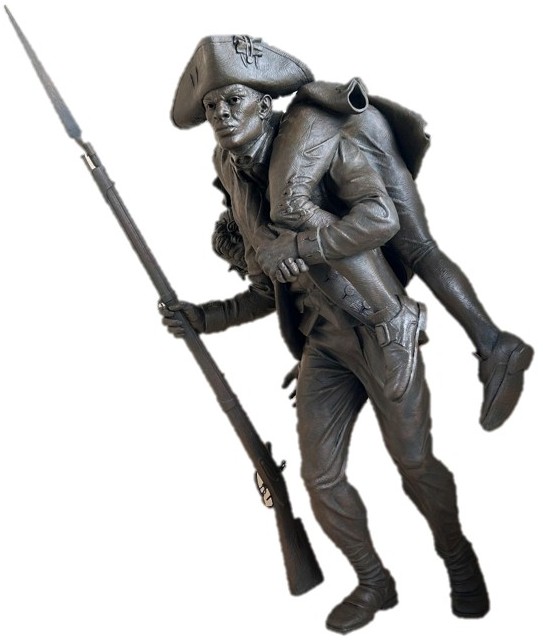
Acts of Agency
Artist: Branly Cadet (b.1964)
Medium: Bronze, granite base
Dimensions: Overall height 82" x 60" width x depth 66"
Collection of the Maryland State Archives [MSA SC 1545-3606a]
At the commencement of the Revolutionary war, there were found in the Middle and Northern States,
many blacks and other people of color, capable of bearing arms [...]
The freeman entered our ranks with the whites [...]
and it is required, in justice to them, to add, that they discharged their duty with zeal and fidelity.William Eustis, Secretary of War, 1820
From the very beginning of the American Revolutionary War (1775-1783), Black and Indigenous people shaped the fight for independence. More than 150 Black soldiers served in Maryland units. The true number is difficult to determine because Black soldiers' race was generally not noted in enlistment records. Researchers at the Maryland State Archives have documented roughly 90 Black soldiers; many others remain unknown.
While this monument represents the service of many, these figures are inspired by a description of the American attack on the British fort at Ninety-Six, South Carolina in 1781. Thomas Carney (1754 or 1759-1828) was a free Black man who enlisted in the Fifth Maryland Regiment. After his captain, Perry Benson (1757-1827), was shot through the shoulder, Carney carried Benson to safety, helping save his commander's life.
Black Patriots in the Continental Army faced the dual burden of potential death in combat
and, uniquely, uncertainty about their liberty at the conclusion of the Revolutionary War.
At best, these patriots faced a future of second-class citizenship, and at worst, enslavement.Branly Cadet
The Continental Army was an integrated, multi-racial force, and approximately 5,000 Black soldiers fought on the American side during the Revolutionary War. In some cases they were allowed only non-combatant roles, but most served in regular infantry units alongside white troops. In Maryland, free Blacks began enlisting by the summer of 1776, and by 1778, enslaved men were permitted to serve as substitutes for white soldiers. After 1780, when the need for additional recruits was particularly acute, enslaved men could enlist on their own accord.
One state, Rhode Island, raised an all Black regiment, and Maryland considered following suit, but the proposal failed in the General Assembly in 1781. Although Black soldiers tended to serve longer tours than their white compatriots, they were generally prevented from ascending military ranks beyond fifer, drummer, or private. More information about the military service of Black Marylanders can be found on the "Black Military Service" Tab.
Do you have information about a Black Patriot you'd like to share? Email us at msa.helpdesk@maryland.gov
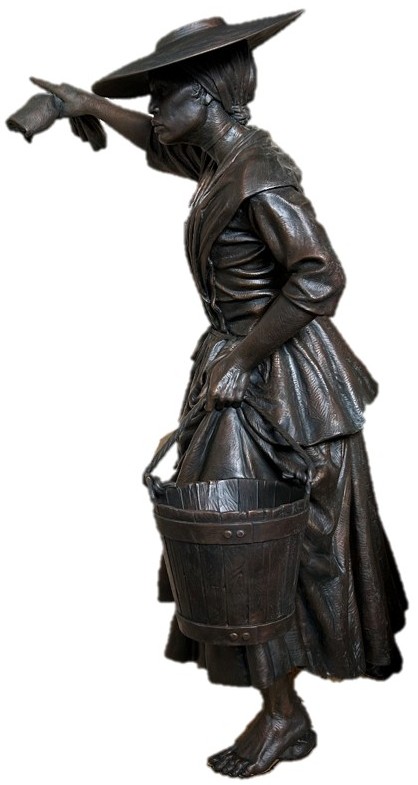
Towards Freedom
Artist: Branly Cadet (b.1964)
Medium: Bronze, granite base
Dimensions: Overall height 76" x 48" width x max depth 48"
Collection of the Maryland State Archives [MSA SC 1545-3606b]
[Rachel] was lately apprehended in the First Maryland Regiment,
[with her] husband, with whom she had been the principal part of this campaign...Fugitive slave advertisement for Rachel and her son Bob, Pennsylvania Packet, October 24, 1778
During the Revolutionary War, women traveled with and worked for the Continental Army, and while the exact number is unknown, historians estimate their number to have been in the thousands. Known colloquially as "camp followers," many were wives, sisters, or children of soldiers. Their motivations were many; some had no safe place to go or lacked economic security without their head of household. Others may have wanted to serve and support their ideals.
Camp followers played a critical role in supporting the army. They cooked their food, mended and laundered their clothing, and cared for the sick and wounded. Both Black and white women shared the same tasks, struggles, and dangers in camp.
During the early part of the Revolutionary War, more soldiers died from disease
than from combat. The washerwoman's service directly saved soldiers' lives.
Symbolically, she also represents the hope of cleansing the new nation of
its nascent injustices and contradictions.Branly Cadet
While they provided necessary support, camp followers were subject to harsh criticism from contemporary observers. Commanders thought they disrupted the army's stability and movements or were an inducement to vice. In order to deter prostitutes or others the army viewed as troublesome, single women were not allowed to follow the army.
Few sources directly reference these women whose voices are seldom heard. Instead, they are mentioned in other narratives or in runway advertisements placed in newspapers such as Mordecai Gist's advertisement for Rachel and her son quoted above. More information about women of the army can be found on the "Black Military Service" Tab.
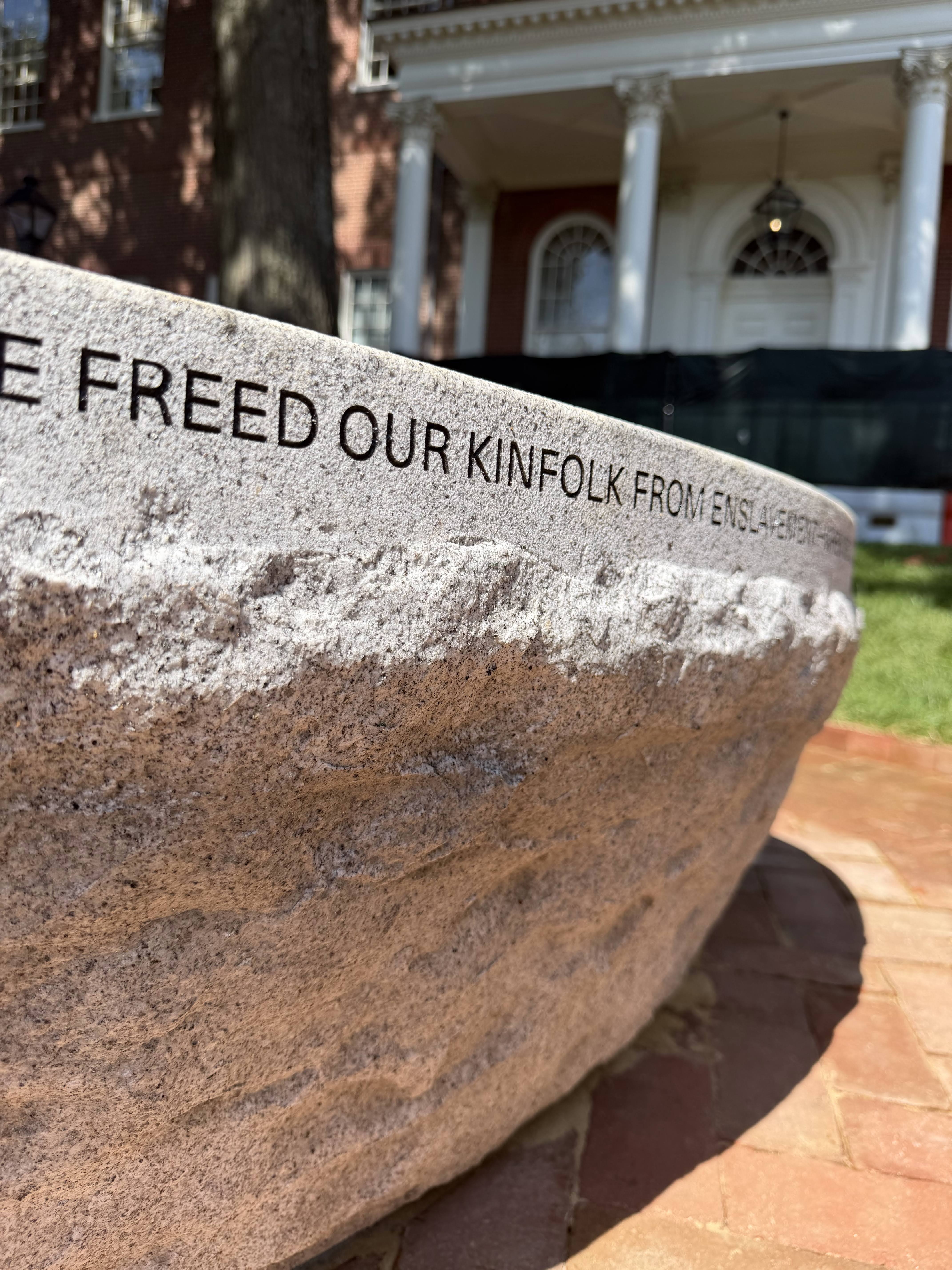
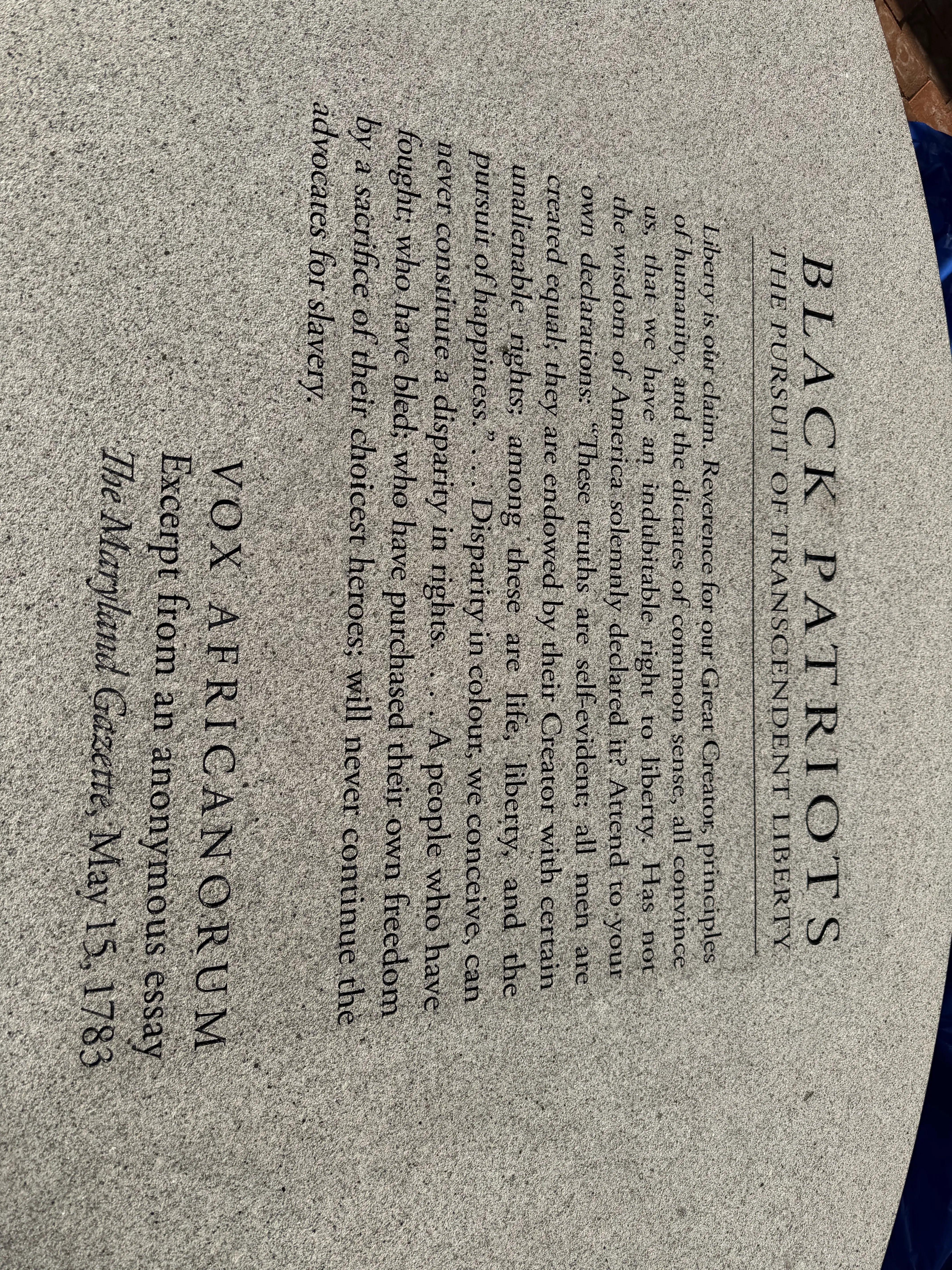
Central Bench
Artist: Branly Cadet and Campion Hruby Landscape Architects
Medium: Granite
Dimensions: 3' x 5'
Let America cease to exult — she has yet obtained but partial freedom."Vox Africanorum", Maryland Gazette, May 15, 1783
The narrative band around the central bench element reads:
- WE STRUGGLED FOR THE RIGHT TO FIGHT AS PATRIOTS
- WE FOUGHT TO ACHIEVE INDEPENDENCE FOR OURSELVES AND THIS NATION
- WE SERVED LONGER ENLISTMENTS THAN MOST
- WE STROVE TO LIBERATE OURSELVES FROM A RESTRICTIVE SOCIETY
- WE FREED OUR KINFOLK FROM ENSLAVEMENT—WHEN WE COULD
- WE AWAKENED THE HEARTS AND MINDS OF SOME OF OUR WHITE NEIGHBORS
- WE INSPIRED FUTURE SOCIAL MOVEMENTS ROOTED IN OUR EXAMPLE OF SERVICE
The top of the central bench includes an excerpt from a column-length piece entitled, "Vox Africanorum," published in the Maryland Gazette on May 15, 1783. It reads:
Liberty is our claim. Reverence for our Great Creator, principles of humanity, and the dictates of common
sense, all convince us that we have an indubitable right to liberty. Has not the wisdom of America solemnly
declared it? Attend to your own declarations: 'These truths are self-evident; all men are created equal;
they are endowed by their Creator with certain unalienable rights; among these are life, liberty, and the
pursuit of happiness.'... Disparity in colour, we conceive, can never constitute a disparity in rights...
A people who have fought; who have bled; who have purchased their own freedom by a sacrifice
of their choicest heroes; will never continue the advocates for slavery.
Presumably written by one or more Black Marylanders under the pseudonym, "Vox Africanorum," the self-titled piece eloquently and forcefully demonstrated that the fight for transcendent liberty would be an ongoing struggle in the New Nation. It fervently defended the cause of American independence from Great Britain, while simultaneously pointing out that the existence of slavery in Maryland actively denied "life, liberty, and the pursuit of happiness" from thousands of Black Marylanders. Though published in 1783, it remains one of the most important documents of the Revolutionary Era.
To learn more about this essay, visit the Vox Africanorum page. To dive even deeper into Black history in Maryland generally, visit the Legacy of Slavery in Maryland Program's website.

Landscape
Artist: Branly Cadet and Campion Hruby Landscape Architects
The landscape design tells a story connecting the figures and their experiences as Black patriots during the Revolutionary War. Coming from a recent battle, the soldier carries a wounded comrade on his shoulders. They approach a river, indicated in the landscape by tall grass and a series of large stones, where a woman had been washing soldiers' uniforms. She points, directing the soldier to assistance. While this scene is not recounted in a specific historical narrative, it calls attention to the service and sacrifice of soldiers and camp followers.