


Agnes Kane Callum
1925-2015
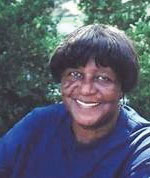
Agnes Kane Callum was a prominent historian and genealogist known for her research on Maryland’s African American history, particularly the history of enslavement in St. Mary’s County, and her family lineage. Her passion and work greatly inspired others to become interested in African American history and research and their own genealogies.
Callum was born in Baltimore, Maryland, the fifth of twelve children to Phillip Moten and Mary Gough Kane of St. Mary’s County, Maryland. She was educated in Baltimore City public schools and started working a variety of jobs while active in her community, joining the Eastside Democratic Organization. In 1967, she helped found the Cleanup Association for a Better Neighborhood to promote upkeep in her neighborhood. At age 44, she returned to school and earned her Bachelor of Arts and Master of Arts in Social Sciences from Morgan State University in 1973 and 1975, respectively.
In 1973, she was designated a Fulbright-Hayes Scholar and studied at the University of Ghana at Legon. As an undergraduate, she wrote a paper for a Black History class titled “The Acquisition of Land by Free Blacks in St. Mary’s County Maryland.” This research enabled her to begin to investigate and document the genealogy of her family. Callum published her first book, Kane- Butler Genealogy – History of a Black Family (1979). She founded, edited, and published an African American genealogical journal for 25 years, Flower of the Forest, named after a tract of land in St. Mary’s County that the Butler family members owned for nearly 125 years.
Her paternal grandfather, Henry Kane, was born enslaved on the Sotterley Plantation in Hollywood, Maryland, now a historic site, in 1860. She joined the Board of Trustees of The Sotterley Plantation in the mid-1990s. Her research of enslaved life on the plantation is used as the basis for the hands-on educational program “Slavery to Freedom” at Sotterley. In 2012, she was designated a Trustee Emeritus.
Much of what is known about the historic St. Francis Xavier Catholic Church in East Baltimore is the result of Callum’s work. St. Francis is the first and oldest Catholic parish officially established for African Americans in 1863. Henry Kane joined the parish in 1896, and his descendants have been continuous members since.
A frequent columnist for The Catholic Review, she wrote about Colonial Maryland and the role played by people of African descent, including Mathias de Sousa, an indentured servant brought by Jesuit missionary Fr. Andrew White on the Ark when it arrived in St. Mary’s River in March 1634.
A tenacious researcher, she produced additional books, including Colored Volunteers of Maryland, 7th Regiment United States Colored Troops 1863 - 1866 about African Americans who served in the Civil War; Slave Statistics of Saint Mary's County, Maryland, 1864: Commissioner George B. Dent; Black Marriages of St. Mary’s County 1800-1890, and Black Marriages of Anne Arundel County Maryland, 1851 to 1886. In 2006, a complete collection of her work, 19 volumes, was donated to the Reginald F. Lewis Museum of Maryland African American History and Culture in Baltimore.
She was a founding member of the Baltimore Afro-American Historical and Genealogical Society (BAAHGS). This group was renamed the “Agnes Kane Callum” chapter in her honor in 2007. In 2008, she received an honorary doctorate in history from St. Mary’s College of Maryland.
Callum married Solomon Melvin Callum of Jamestown, South Carolina. She had five children, two of whom predeceased her: Paul Ambrose Foster, Arthur Melvin, Martin J. Callum, Agnes C. Lightfoot, and Martina P. Callum, M.D., a Family & Emergency Medicine Physician. Callum died at age 90 on July 22, 2015, from Parkinson’s disease.
“I still think this survival was most important and the continuity of [Historic Sotterley] is important because…[it] will help to make it understandable to the children so they will have some faith in the plantation.” - Agnes Kane Callum, 2011 interview with Historic Sotterley.
Biography courtesy of the Maryland Commission for Women, 2014; updated 2023