


Edith Clarke
1883-1959
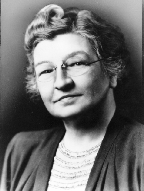
Edith Clarke was a mathematician, inventor, electrical engineer, and trailblazer for women in the field of computing and engineering. She was the first woman to become a professional electrical engineer in the United States during a time when men dominated the field.
Clarke was born in Howard County, Maryland, on February 10, 1983, to John R. and Susan O. Clarke. Her parents died when she was 12 and left her an inheritance, which she received at 18 and used to further her education, going to Vassar College in 1865, where she concentrated on mathematics and astronomy. She graduated with a Bachelor of Arts degree with honors and a Phi Beta Kappa key in 1908. She taught math at several colleges but eventually became disillusioned with the career. In 1911, after a serious illness, she decided to return to school and study engineering. This was something she always wanted to do. She enrolled at the University of Wisconsin and worked during the summers for AT&T in New York. She was hired as a “computer,” someone who solved mathematical equations.
Clarke left New York in 1918 to enter the Massachusetts Institute of Technology (MIT), earning a master's in electrical engineering. She was the first woman to earn a degree in that field from MIT. Due to limited opportunities for women in the engineering field, Clarke went to work as a computer again, this time for the Turbine Engineering Department of the General Electric Company (1919-1921). During this time, she filed a patent application describing her invention of a graphical calculator to be used in the solution of electric power transmission problems.
Anxious to see the world, Clarke took a leave of absence to travel throughout Europe (1921-1922). She taught physics for a year at Constantinople Women's College in Turkey. Upon her return to New York, Clarke finally achieved her life-long goal, to work as an engineer for the Central Station Engineering Department of General Electric. This made her the first professionally employed female electrical engineer in the United States and the first woman to be accepted as a full voting member of the American Institute of Electrical Engineers (AIEE, which became IEEE in 1963). She retired in 1945 and became a Fellow of AIEE in 1948, the first woman to be so honored.
Clarke authored or co-authored nineteen technical papers between 1923 and 1951. She was the first woman to present an AIEE paper (1926), later published in the Transactions of the AIEE. In 1941, she and a colleague, Selden B. Crary, were awarded "Best Paper of the Year." Additionally, Clarke authored a two-volume reference textbook, Circuit Analysis of A. C. Systems.
In 1947, she became a full professor at the University of Texas in Austin. This made her the first woman to teach in the engineering department at the University of Texas. She retired for a second time in 1956, and returned to her farm in Howard County. Clarke received the Society of Women Engineer's Achievement Award in 1954 and was selected for inclusion in Women of Achievement in Maryland History (1998), the American National Biography, and the Notable American Women of the Modern Period. Clarke died in 1959 at the age of seventy-six.
“As a woman who worked in an environment traditionally dominated by men, she demonstrated effectively that women could perform at least as well as men if given the opportunity. Her outstanding achievements provided an inspiring example for the next generation of women with aspirations to become career engineers.” - James E. Brittain, IEEE Transactions on Education, vol. E-28, no. 4, November 1985
Biography courtesy of the Maryland Commission for Women, 2003; updated 2023.