


Lois Green Carr, Ph.D.
1922-2015
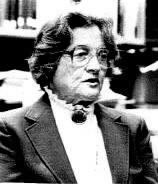
Lois Green Carr made an indelible contribution to the State of Maryland in her professional and personal calling as Maryland’s preeminent Chesapeake historian. She vastly increased our knowledge about early Maryland and its role in colonial American history. Through her work among records of our past, she was humorously characterized as the woman who knew not only the names of everyone in seventeenth-century Maryland but also their addresses and telephone numbers!
Carr was born in Holyoke, Massachusetts, on March 7, 1922, to Donald R. and Constance McLaughlin Green. Her mother won the 1963 Pulitzer Prize in history for Washington, Village and Capital, 1800-1878. Her grandfather, Andrew C. McLaughlin, won a 1936 Pulitzer Prize for his work, A Constitutional History of the United States. She earned a bachelor's degree from Swarthmore College (1943), a master's from Radcliffe College (1944), and a doctorate in history from Harvard University (1963).
Carr’s work has been internationally recognized and drawn upon for further historical investigations for many years. Her professional life in Maryland began at the Maryland Hall of Records, now the Maryland State Archives, in Annapolis as a Junior Archivist in 1956. After spending more than 40 years at the Archives, she later worked as the historian for Historic St. Mary's City (1967), studying records of births and deaths, inventories, and court records to weave a picture of a lost world - Maryland at the beginning.
When awarding the first annual Eisenberg Prize for Excellence in the Humanities to Dr. Lois G. Carr and Dr. George B. Undarhelyi in 1996, the Maryland Humanities Council wrote the following about Carr:
"Growing up in a household where her mother and grandfather were both historians, Dr. Lois Green Carr never doubted that she too would become a historian. Although her relatives chose the traditional course of university professorship, Dr. Carr devoted her energies to researching and writing about the colonial Chesapeake for all kinds of audiences from school children to professional colleagues. While others concentrated on writing cautiously guarded monographs to advance their professional standing, she chose to share her work with upcoming students and fellow historians, often co-authoring books and articles with her colleagues. Choosing Maryland as her home base after earning her Ph.D. from Harvard University in 1968, she was one of the driving forces behind the St. Mary’s City Commission and is today internationally recognized as the leading social and economic historian of the Colonial Chesapeake."
Carr had an eagerness to share her knowledge, which was uncommon in the field of history. Because of this, she had a strong, positive influence on several generations of scholars. Carr directed research on a diversity of subjects, ranging from the experiences of women in 17th-century Maryland and colonial inequality to the development of local government and religious toleration. Her efforts with land and court records provide the historical baseline for discovering the history of the State of Maryland’s first capital, St. Mary’s City, and of the people who lived there.
Carr served as the president of the Economic History Association in 1990-91 and was recognized as a leader in the fields of social and economic history. Through her pioneering work with probate inventories and other seldom-used types of documents, she led the way in the field of New Social History.
Her book, Robert Cole’s World: Agriculture and Society in Early Maryland, co-authored with Russell R. Menard and Lorena S. Walsh, was reviewed as “…a stunning achievement…” by Carville Earle and “The finest book ever written on agriculture in seventeenth-century America” by Peter A. Coclanis. Robert Cole’s World won the Maryland Historical Society Book Prize in 1993 and received the Alice Hanson Jones Prize, given by the Economic History Association for an outstanding book in North American Economic History published during 1991-1992. Readers of the William and Mary Quarterly voted the essay "The Planter’s Wife: The Experience of White Women in Seventeenth-Century Maryland" (1977), co-written with Lorena S. Walsh, as one of the 11 most influential articles published during the journal's first 50 years.
Carr earned the respect and admiration of a wide circle of colleagues. In 1992, a conference in her honor was held at the University of Maryland College Park, and resulted in a published "festschrift" of the papers presented on that occasion. Entitled "Lois Green Carr: The Chesapeake and Beyond - A Celebration," the symposium celebrated Carr's accomplishments as a uniquely gifted and generous historian. The program participants represented a veritable "Who’s Who" of early American historians and economists.
Carr married and later divorced Allen R. Clark, with whom she had a son, Andrew Clark. Her second husband was Jack Ladd Carr. She died at age 93 on June 28, 2015, peacefully at her home in Annapolis.
Carr was internationally recognized as the leading social and economic historian of the colonial Chesapeake region. According to Dr. John J. McCusker, Distinguished Professor of American History and Professor of Economics at Trinity University in Texas:
“She has been the answer to many a question, the idea behind many a paper, the thoughtful critic for young and old, a particular stimulus to those of her gender, and a role model for us all who seek to work in the history of early America.”
Biography courtesy of the Maryland Commission for Women, 2000; updated 2023.