
| February, 2002 |
|


Stage Whispers By Guest Author Lucia Mauro
Stage Whispers
By Lucia Mauro
Editor's Note: This article was first published in the November 2001 issue of NorthShore Magazine. This article has been re-published with the permission of both NorthShore and the author.
Thank the military for increasing the accessibility of art.
Interestingly, one of the latest technological advancements making it possible for deaf and hard-of-hearing audiences to enjoy live theater grew out of military research to provide specialized goggles for fighter pilots.
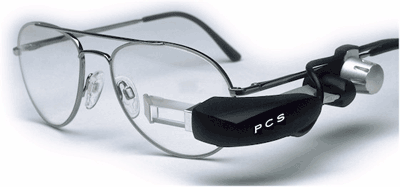
Earlier this year, Chicago's Victory Gardens Theater demonstrated "eyeglasses that hear," a new device being tested by Personal Captioning Systems of Morton Grove. These clip-on eyeglass units, called See-Through Captioners, have a tiny monitor built into the frame that scrolls the text of a play so the words seem to "float" 18 inches in front of the eye. The text is transmitted to personal TV monitors and See-Through-Captioners in the house via a laptop computer.
The eyeglasses are available in different prescriptions and include clear lenses for theatergoers with 20/20 vision. Viewers relax their eyes the same way they would gaze into a microscope and soon words and stage action seamlessly merge.
PCS co-founder Murray Fisher says the concept can be traced to eyewear developed for United States Air Force fighter pilots, who view crucial geographical data through their lenses without having to look down at a separate monitor. In the skies as on stage, she says, "The eye and mind are able to blend the images so that everything is in the line of sight."
This is an inspiring example of how technology can bring together audiences of varying abilities. Viewers tested the glasses while actors performed scenes from Javon Johnson's Hambone on Victory Gardens' mainstage. They also had the option of watching the more obtrusive super-titles projected onto the stage, or a more personal captioning device, which transmits the text of a play in real time to flexible, palm-sized personal TV monitors attached to armrests.
 D.
D.
The See-Through Captioners.
Personal Captioning Systems, which Fisher founded two years ago with Dan Deignan, does captioning for movies, live theater, classrooms, sporting events and courtroom proceedings. What makes these eyeglasses particularly appealing in a theater is that they can be used on any performance night.
"It's very limiting when you're only given the option of attending specific captioned performances," says playwright Mike Ervin, co-director of Victory Gardens' Access Project. "This system allows persons with disabilities and able-bodied audiences to experience a production together."
The system also will benefit people who can hear but have communication difficulties such as autism, dyslexia or language processing disorders. "They respond better to the written word than the spoken word," Ervin says.
Fisher, a Victory Gardens subscriber, invited the theater to try out his company's portable captioned TV monitors two seasons ago. The "hearing eyeglasses" are the next logical step in Victory Gardens' long-term commitment to barrier-free theater. In 1995, the theater assumed leadership of the Access Project- a program making performances accessible for people with disabilities - from the defunct Remains Theater. Now, each season more than 40 mainstage performances are interpreted in sign language, word-for-word captioning or with audio description. The entire space has been modified to meet the 1990 Americans With Disabilities Act's regulations.
Sandy Shinner, Victory Gardens' associate artistic director, co-manages the Access Project. She recalls how initial word-for-word captioning methods involved hauling two huge computer screens (weighing 250 pounds each) onto the sides of the stage.
Ronald Jiu, a deaf actor and director, is glad the system has been improved. "The problems [with captioning outside ones field of vision] are trying to watch two things - actors and captions - at the same time," he says.
Victory Gardens then teamed up with Caption First, a company that pioneered the idea of projecting captions directly onto a screen on stage. "Our goal was to make captioning as integral to the whole production as possible," adds Shinner.
Even with on-stage visuals, Jiu notes, "It [depends] on where a producer puts the screen on the wall in every production. Also the time of the caption may fall behind or ahead of time to match actors speaking their lines."
Victory Gardens devotes a lot of time to synchronizing the spoken and written texts, and is especially aware of not flashing the punch line of a joke before it's uttered. Shinner points out that "hearing" subscribers typically opted out of captioned performances because they found the projected text distracting.
Victory Gardens currently offers on-stage captioning, individual TV monitors, eyeglasses and signed performances. Shinner, however, is concerned that theaters may not be able to afford the eyeglass units - the biggest roadblock in making the noble dream a large-scale reality; each pair costs $1,900.
Deignan of PCS predicts that the eyeglasses will drop to less than $500 a piece within a year. That's still a hefty budgetary addition to small- and mid-size theaters engaged in a perpetual battle for funding. Most theaters in Chicago opt for designated sign-interpreted performances.
David Zak, artistic director of Bailiwick Repertory Theater and cofounder of the Deaf Bailiwick Artists program, calls the glasses "a great breakthrough," but wonders how he would pay for them.
Fisher is talking to cinemas and studios in the hope that introducing the technology in movie theaters might help drive down prices for everyone.
More immediately, Fisher's company is willing to assist theaters with their grant writing and fundraising and is in the process of establishing a network for theaters to share one of his company's systems. He has discussed this possibility with Victory Gardens and Northbrook's CenterLight Theatre, which specializes in simultaneously signed and voiced performances.
"This is a grassroots effort," asserts Fisher. "We want to provide everyone with the ability to see and hear theater from any seat in the house."
