
| February, 2002 |
|


Link Global: 508 and the Facts
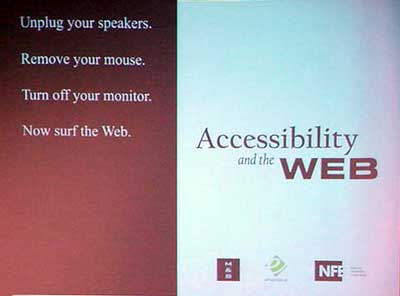
"Unplug your speakers. Remove your mouse. Turn off your monitor. Now surf the Web."
This is the barrier that people with certain disabilities face every time they surf the web. In the attempt to solve this problem, laws have been made, companies have been sued, and no one is entirely satisfied with the present situation.
On January 9, 2002 the Greater Baltimore Committee held its Breakfast Briefing Seminar Series on Accessibility and the Web. With presentations by Drew Krimski, the president and CEO of The ACI Group, Curtis Chong, the Director of Technology for the National Federation of the Blind, and Michele Cohen, a technology lawyer with Miles & Stockbridge, a full gamut of Section 508 issues were discussed.
Beginning with the basic definition of Section 508 of the Rehabilitation Act, as provided by The Architectural and Transportation Barriers Compliance Board (Access Board), "The law applies to all Federal agencies when they develop, procure, maintain, or use electronic and information technology. Federal agencies must ensure that this technology is accessible to employees and members of the public to the extent it does not pose an 'undue burden,'" the seminar addressed such 508 related issues as laws, guidelines, target markets, and compliance strategies.
 D.
D.
The main screen of the PowerPoint presentation, it effectively summed up the barriers a person with disabilities faces when trying to navigate through the Internet:"Unplug your speakers. Remove your mouse. Turn off your monitor. Now surf the Web."
Curtis Chong opened the seminar with a demonstration of a screen reader (a devise used by the blind and visually impaired to navigate through the web) and the obstacles a vision impaired individual faces when visiting websites that are not fully compliant. Chong went on to explain that only about 40% of the sites he visits are fully accessible, while 50% are do-able, though not particularly good, and nearly 10% are not accessible at all. In fact, America Online, one of the largest ISP's in the U.S., was sued by the NFB in 1999, claiming that AOL failed to adhere to the provisions of the ADA because it's software packages were not compatible with screen-access software typically used by the blind. Though AOL eventually settled the suit by agreeing to work with the NFB in order to ensure the accessibility of its site and software, the suit did not determine whether or not companies should be mandated to make their sites accessible to the disabled.
The NFB takes the stance that the blind or visually impaired person does not necessarily want to see what a sighted person sees, the individual just wants to be able to extract the same data as a sighted person. Thus, those with disabilities must be able to access the information from the web, regardless of the format of the sites themselves. For instance, a PDF file (portable document format) is unusable to the blind on the web because it is an image, not text. And when that image conveys no information and no way to enter it (like connecting to the links in a PDF), then the site proves useless.
 D.
D.
Curtis Chong, Director of Technology at the National Federation of the Blind, explains how a screen reader works and the current problems facing the blind and visually impaired when navigating the Web.
However, with the requirements of Section 508, the Federal Government and those who work closely with the Fed's, such as government contractors, healthcare providers, distance learning providers, and solution developers, will all need to work together to meet federal procurement requirements.
Drew Krimski, President of effective-e (a division of the ACI Group), designs and builds web-based business solutions. He spoke on the importance of compliance, the necessity for training in accessibility techniques, and development/remediation of sites themselves. Furthermore, he provided a number of facts about the market/target group for Section 508:
- 500 million disabled worldwide
- 50 million disabled in US
- 14 million disabled use computers
- 8 million disabled Web users
- 1.2 million disabled in Maryland
- 300,000 disabled own computers
- 200,000 disabled Web users
- Maryland's total population is 5,375,000, which increased by 79,000 after the most recent census update. Maryland is the nation's 19th largest state and had the 11th largest numerical gain in population.
Sources: US Census; Forrester Research; H.S. Kaye 2000
Computer and Internet Use Among People With Disabilities. Disability Statistics Report (13). Washington, DC: National Institute on Disability and Rehabilitation Research.60% of people with at least one disability have never used a computer, compared to 25% in the general population. Furthermore, people with disabilities were only half as likely to live in homes with Internet access compared to those without a disability.
Source: U.S. Dept. of Commerce
 D.
D.
Drew Krimski explaining the importance and ultimate necessity for not just government but private commercial website accessibility.
The final speaker, Michelle Cohen, a technology lawyer for Miles & Stockbridge, discussed the various laws surrounding and implementing Section 508. From Federal agencies to contractors doing business with the state, each must be aware and versed in the guidelines. Not only must employees be accommodated, but all government services must be accessible to those using the Internet.
 D.
D.
Part of the PowerPoint presentation at the seminar, issues surrounding the law and Section 508 were given special attention.
The basic compliance guidelines for 508 declare that there need to be text equivalents for all graphics and equivalent alternatives to multimedia. The guidelines also include special rules for tables, frames, and scripting. Though compliance standard website tests, particularly compliance tests that can be downloaded from the Web, have become a popular effort, one remains the most popular, although outdated. Bobby, a web program that can scan a site for accessibility is perhaps the most popular since it provides an easy automated check; unfortunately, it does not meet the accepted standards and has no guarantee. Often, it misrepresents a site as certified, especially on sites where navigation is icon-based, when in fact the site is still inaccessible to screen readers. The most comprehensive compliance standards can be found through WAI (Web Accessibility Initiative), but it is Section 508 that still provides the most practical compliance guideline currently available.
Though the Rehabilitation Act is limited to the Federal sector, the standards of accessibility required of those interacting with the Federal government will inevitably change. It will prove fruitful for independent corporate entities to concur with compliance guidelines, if for no other reason than to increase their customer bases while limiting ADA claims filed by disabled consumers. As Section 508 becomes an increasingly popular subject among businesses and the courts, it will inevitably be up to the law to determine whether or not companies must make their websites accessible to individuals with disabilities.
Editor's Note:
Section 508 requires that all software and hardware bought by the Federal government be accessible to all users. In 2000, the state of Maryland took steps to make sure that its non-visual users had the same access to information technology as sighted users. Through the inaction of House Bill 592 and Senate Bill 607, both provide for non-visual access to information and information systems, such as computers and kiosks provided for the public by the state. Furthermore, the bills require any equipment procured by the State of Maryland to be suitable for non-visual access.
For information on the Non-Visual House Bill 592 and Non-Visual Senate Bill 607:
To view them on the web, visit the Maryland General Assembly site at http://mlis.state.md.us.
Synopsis of House Bill 592:
Requiring the Chief of Information Technology in the Department of Budget and Management to issue and enforce non-visual access standards to be used in the procurement of information technology and the provision of information technology services by or on behalf of units of State government; requiring the adoption of the standards on or before January 1, 2003; requiring the inclusion of a non-visual access clause in each request for proposal or solicitation of bids in State procurement; etc.
For House Bill 592 visit: http://mlis.state.md.us/2000rs/billfile/hb0592.htm
Synopsis of Senate Bill 607:
Requiring the Chief of Information Technology in the Department of Budget and Management to issue and enforce non-visual access standards to be used in the procurement of information technology and the provision of information technology services by or on behalf of units of State government; requiring the adoption of the standards on or before January 1, 2003; requiring the inclusion of a non-visual access clause in each request for proposal or solicitation of bids in State procurement; etc.
For Senate Bill 607, visit: http://mlis.state.md.us/2000rs/billfile/sb0607.htm
