
| December, 2001 |
|


Accessing a Higher Education in Assistive Technology
Every human being lives to learn. However, if you are disabled, the endeavor to learn will all too likely include a lack of fundamental technology and accessibility. Especially as the need for higher education becomes a near necessity in the twenty-first century, many individuals with disabilities are facing educational barriers that could alter the outcome of their college experience. At the Fourth Annual 2001 Assistive Technology in Higher Education Conference, Accessing Higher Ground, at the University of Colorado at Boulder from November 14th - November 16th, educational barriers were exposed, solutions sought, and guidelines/standards addressed. With lectures by Doug Wakefield, the author of the Access Board's 508 regulations, Paul Grossman, from the Office of Civil Rights, and Laurie Vasquez of Santa Barbara City College, to name a few, a broad range of issues were covered. Lawrence Scadden, the senior program director in science education for the National Science Foundation was the keynote speaker at the conference. Scadden has spent many years working towards equal access to science, education, and technology for individuals with disabilities. Technology and the law as it relates to providing for the needs of students with disabilities is perhaps one of the key issues addressed at the conference. According to section 504 of the rehabilitation Act of 1973, "No otherwise qualified handicapped individual in the United States...shall, solely by reason of...handicap, be excluded from participation in, be denied the benefits of, or be subjected to discrimination under any program or activity receiving federal financial assistance." Therefore, colleges or universities that are receiving any federal financial assistance must not discriminate amongst students. Furthermore, students with disabilities may request modifications, accommodations, and auxiliary aids that would allow them to fully benefit from their education program and other activities. However, the difficulty rests in assuring the full extent of educational accessibility. A look at the information from the 2001 4th Annual Assistive Technology in Higher Education Conference
 D.
D.
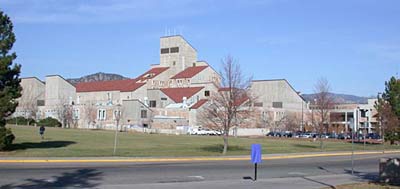
University of Colorado at Boulder; the Engineering Building.
 D.
D.
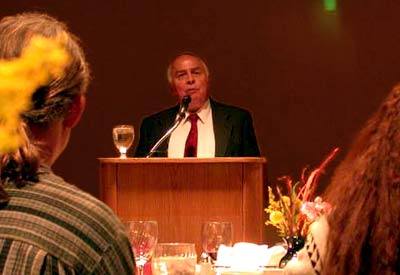
Dr. Lawrence Scadden giving his keynote address to a large audience.
Schools have many issues to face when learning about and providing technology for individuals with disabilities. From various assistive technology equipments to accessible distance learning, the needs of the students must be addressed in an equitable context. One of the most important aspects of providing an equitable education to a student with disabilities is making all information resources accessible: computer labs; email systems; online systems; research and catalog systems; websites; distance learning; and business services. The problem is that many schools, their professors, and their staff are unsure of how to choose and implement the technology that would remove communication barriers.
Although terms such as "eliminating hostile environments," and "equally effectively" are frequently used when describing the means and methods for breaking down communication barriers for the disabled, they are not often fully understood in the context for which they apply. "Equally effectively" does not mean that a student with a disability needs or should have identical treatment in information retrieval; rather, the programs that the student uses to acquire that information need not be fundamentally altered. Thus, modifications and adaptations should be made for equal access but the integrity and quality of the program should remain intact, i.e. fundamentally the same for all students. Likewise, eliminating hostile environments does not mean that paternalism and dependence should innately become part of the students' higher education experience, but that the communication systems should be welcoming to all students. By removing the unnecessary barriers, the information world at a college campus will endorse self-reliance and independence while eliminating barriers, such as a lack of networking and connectivity, that would inhibit a student from wanting or being able to competently and independently use software him/herself.
 D.
D.
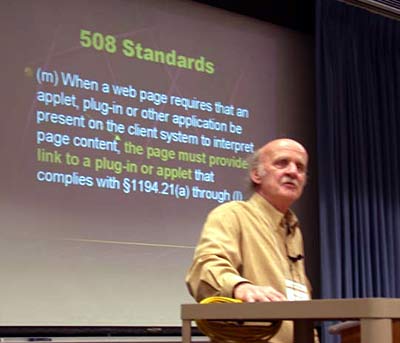
Dick Banks, of EASI, discusses 508 standards.
As information resources expand beyond the traditional, it is important that accuracy be key to the dissemination of information. Issues such as fully accessible computer labs and access to the Internet anywhere and anytime are fundamental to the quality of learning for students. Accuracy and variety among print media is also pertinent, such as providing not only readers and books on tape, but Braille versions of print media, in order to allow time to re-read and effectively study.
 D.
D.
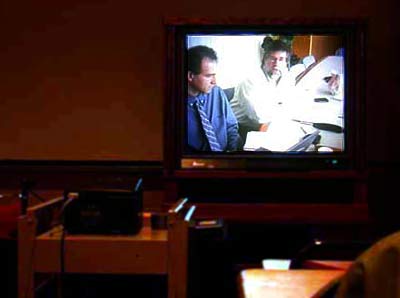
Larry Goldberg and Geoff Freed, from the National Center for Accessible Media, hold a teleconference session on Access to Online Learning and other Educational Technologies.
But what if a student is unable to work in the traditional classroom or college setting? What, then, are the learning alternatives for that student?
Distance learning is a growing trend for many schools, providing people who work long hours, who work from home, and individuals who are ill or who have disabilities to access the course without having to find a way to access the campus. With an informal style, students utilizing online courses have the ability to express themselves more freely without necessarily experiencing the stage fright that often comes along with sitting a classroom. However, it is important to maintain a virtual classroom that is universally designed, including videos, PowerPoint presentations, graphics, math texts, alternative print formats, and audio sound. By utilizing all communication sources, the teacher can create a welcoming space in which to interact with all the students.
 D.
D.
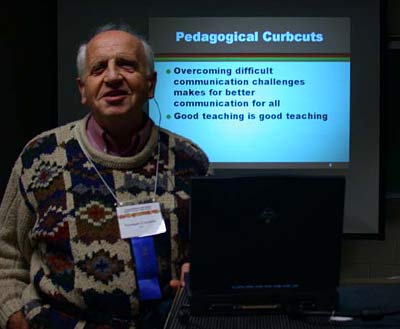
Norm Coombs, a blind professor from RIT, who has explored
"distance learning" as an equal oportunity educating method, discusses the fundamentals of the process.
There are many issues that the Disability community faces in the new century. With changing laws and even faster evolving technology, it is important to continually revise and reassess the roles that colleges and universities play in the educational development of individuals with disabilities. It becomes the schools responsibility by law and by social contract to maintain a universal education curriculum that would allow all students to access information in barrier-free environments. Through the use of these workshops and conferences, such as Accessing Higher Ground, professors, technology professionals, and students can work together to remove the barriers that many students currently face and create a universally designed education program in which each student will have equal access and opportunities.
