 |
May 1999
|
 |
|
 |
|
|
|
May 1999
|
| |
|
|
|
|
 D.
D.
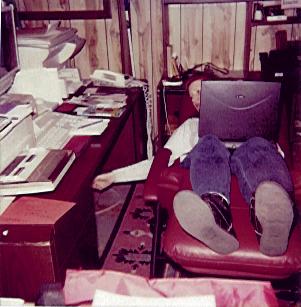
Louise being evaluated for computer placement.
By Louise Bankston Calderan, MD TAP staff
The title is aptly chosen as it reflects a running theme in my life. You know the drill, you are hankering for a piece of cherry pie. You get to the counter and they tell you either they no longer carry it or they just ran out. Et cetera, et cetera. In keeping with that theme, I find myself in the predicament of having a condition that requires a type of technology not yet developed for it. Figures, right? Well, it is in these situations that geniuses are born and man reaches a greater zenith in his capacity for living and adapting to the universe. Or so one would hope… In my case? We will see.
After several cancer-related surgeries, I found myself with a condition known as Lymphedema. (This was the first "Why me?" By this time I had grown used to this phenomenon and adapted to it quite readily.) The condition is described as a blocked lymphatic system causing swelling limbs. I seem to have the most problem with my left leg. In fact, I've had the Lymphedema since my first surgery in 1989. It has gotten worse since the last surgery in 1996. There is no cure for this. It can only get worse.
Oh sure, there are compression pumps to pump the fluid out of the limbs, but there is much controversy surrounding that method of treatment. Due to the possibility of blood clots, it is not always the wisest and safest solution. Another method of treatment requires a constant bandaging of the limb. This method keeps the fluid from building up in the first place. This method, combined with compression stockings and elevation is the only true safe and effective long-term solution to keeping this condition under control. Oh, did I happen to mention a lower back problem that defies explanation? That's another story unto itself. Take my word for it, it's there. BOY, is it there!
So, you say, how does that affect someone's everyday life? Well, let's examine that. How does one drive a car with one's leg elevated? Oh - that's a good one. I used to drive with my foot up on my dashboard. Doctors were afraid of me throwing my hips out of alignment doing that. I did have a bit of flexibility to carry it off. After all, I reasoned, you only need one foot to drive, right? That worked for awhile until I put on more fluid and more weight. For now, bandaging is going to have to do. I did ask some companies that did adaptations to vehicles for wheelchairs why there aren't any designs for people in my situation. They said they had never heard, nor encountered this problem before. Surely there are lots of folks out there in my situation? Hello?
D.
Louise working the old way.How does one manage at work? Okay. First I'd put my leg up on my desktop. After all, it was certainly high enough to help drain the fluid. But not exactly comfortable (especially in dresses), nor did it look entirely appropriate. Okay, so let's try a desk drawer, or perhaps another chair. These options were not satisfactory - to anyone. They took up quite a bit of space, not to mention being just a tad uncomfortable.
Solution anyone? Hello? I am fortunate that I happen to work with the greatest bunch of professionals in the state. TAP's office just happens to reside within the walls of the Maryland Rehabilitation Center located on Argonne Drive in Baltimore. I knew if anyone could come up with a solution, it was the Division of Rehabilitation Services. I thought to myself, I am not disabled and would never qualify as a client of DORS. I was already employed. Why would I need DORS and why would they want me? So began my journey into the foray of going from abled to dis-abled. I met with a field office of DORS in Anne Arundel County, where I resided at the time. We talked, I gave her my medical records, and she informed that I did, indeed, qualify. I was shocked, of course. So what did I need from DORS? Well, let's see. A way to work and elevate my leg. That would eliminate the need for a noisy, heavy compression pump being transported around twice a day from home to work. Something ergonomic that would accommodate my back problems. Gee, that sounded easy enough. An appointment was set up with the Physical Therapy (PT) and Rehabilitation Technology Services (RTS) departments.
Now here's where the luck changes (from "Why me" to "Why NOT me?"). (For over a year, I had been searching for some kind of office chair that would fill the bill. I even tried the AbleData database for ANYTHING that might work. No luck. There was always something not quite right about it.) Short of asking for a recliner chair (oh - wouldn't that have been just heaven, not to mention non-productive!) I was, shall we say, stuck. It just so happened that days before my appointment with PT and RTS, DORS has just gotten in on a trial basis a chair from the Relax the Back Store. I had looked at this chair months before, but discounted it, and you'll soon see why. Take a look at the picture of me in the chair.
Now honestly, would you allow one of your employees to work like this??? I don't think so! Even if you did, can you imagine working like this? I must mention also, that at the same time I had been working with the Volunteers for Medical Engineering (VME) to come up with a way to adapt an electric wheelchair that had been donated to me. The PT department evaluated the wheelchair and it was decided that since the chair was not designed to be sat in with the legs elevated above heart level, it would cause undo stress on the lower back area, even if I had custom padding made to accommodate the curvature of the spine, etc. They had me get in the new recliner type chair. Oh boy! Was this heaven. But how could someone work feeling like they were upside down? Of course, it's going to have its challenges.
I have the chair now in my office as you can see, but the work space now has to be adapted to accommodate the chair. This is what I call Phase II. Since I recline at such a low level, I must move my equipment to within arm's reach. This means moving my scanners and printers down near the floor so I can reach the tops of the machine. I had to get a laptop computer to work efficiently from my chair without eye strain or twisting in my seat. I have to move my work files and phone very close to me so I can reach them. Being right-handed means most things are on my right side. For circulation's sake, my area is designed to allow/force me to get up to retrieve my files from the bookcase and filing cabinets, not to mention access to the fax. This is important as no none should be in an elevated position all the time who is ambulatory. Or so I am told.
Because of the way the chair is built, we need to come up with a solution for a small work surface to hover just above my legs. It needs to be adjustable to angle, as I will be sitting at different angles at various times. It has to be height adjustable as well. It also needs to move out of the way when I want to get up and exit the space. The problem exists in that the workspace is a very narrow space as everything needs to be within arm's reach. This means the desks need to be within a foot or so distance from the chair. Just enough for me to squeeze by to get out of the space.
I used a little forethought in planning my space before the chair arrived. I knew I would need more dektop space, and to keep my existing equipment where it was. I had since received some new equipment as I was converting over from one computer platform to another (Macintosh to Windows). I arranged the space so that my desk and credenza would flank the chair on opposite sides. I gave myself a computer desk and a large work surface at the head and foot of the chair, as I didn't know which way I would ultimately be facing. This turned out to be a good move on my part.
After the PT's came to my office and evaluated me in the chair, the equipment I used on a daily basis and how I could move about in the chair, it was remarked that I had done a good job thinking this through and nothing needed to be changed except the direction of the chair. Good for me! The current challenge now is what to use for the adjustable worksurface. We toyed with several ideas and decided to see if a clamp-on monitor stand would work with some minor modifications to it. That idea is currently being reviewed for feasibility. I will keep you posted on a follow up piece in a future issue of TT as the workspace is completed. Just remember, when it looks like there's no solution, make one!
 Home |
 Newsletter |
 Calendar |
 Previous |
 Index |
 Next |
 Contact |
 D.
D.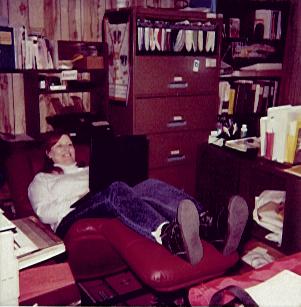 D.
D.