 |
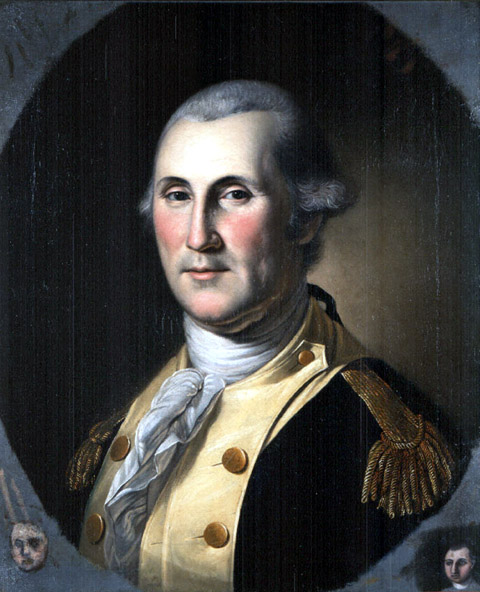
George Washington by Charles Willson Peale
The Peabody Art Collection of the Maryland Commission on Artistic Property MSA SC 4680-10-79 |
The Maryland Senate
February 19, 2001
8:00 p.m.
Old Senate Chamber
The Maryland State House
Annapolis
|
|
George Washington by Charles Willson Peale
The Peabody Art Collection of the Maryland Commission on Artistic Property MSA SC 4680-10-79 |
George Washington, the Potomac River, and the Promise of the Western Lands
This celebration of the life and extraordinary achievements of George Washington is an important annual event in the calendar of the Maryland Senate. It honors our founding father who had close ties to Maryland, to Annapolis, and to the Maryland State House. He visited Annapolis on many occasions and, on December 23, 1783, stood before the Continental Congress, meeting in this Old Senate Chamber, and resigned his commission as Commander-in-Chief of the Continental Army. Washington concluded his resignation speech with the following words: “Having now finished the work assigned to me, I retire from the great theatre of Action; and bidding an Affectionate farewell to this August body under whose orders I have so long acted, I here offer my Commission, and take my leave of all the employments of public life.”
Despite his intention to leave public life, within three months Washington was back in Annapolis, lobbying for a project that had been his dream for 30 years, opening up the western lands by improving navigation on the Potomac River. In 1754, at the age of 22, Washington had surveyed the river from Cumberland to Georgetown and wrote of his expectation that it could become the principal public highway to the west. He also recognized early on that such a bold project would have to be a joint effort of Maryland and Virginia, and, over the years, he worked with the legislatures in Annapolis and Williamsburg to gain support for a public stock company to raise the needed capital. He also recognized that such a project would be to the advantage of not only Maryland and Virginia but “of the Union at large.”
Finally, in 1784, Washington was able to report in a letter from Annapolis to his friend and colleague, the Marquis de Lafayette, that Maryland and Virginia had agreed on a plan for “the extension of the inland navigation of the Potomac, and the communication between it and the Western states.” Washington became the president of the Potomac Company and continued to work on its behalf until 1788, when he was elected the first president of the nation, under the new Federal Constitution.
Program
Session Convenes
The Honorable Thomas V. Mike Miller, Jr.,
President of the Maryland Senate
Presiding
Recess to the Old Senate Chamber
Invocation
Reverend George W. Raduano
Trinity Assembly of God
Lutherville, Maryland
Choral Selections
Soaring Like An Eagle by Linda Spevacek
America the Beautiful
Washington’s Birthday Remarks
Senator Christopher Van Hollen, Jr.
The National Anthem
Adjourn
Choral selections courtesy of the
Southern Senior High School Chamber Choir, Harwood, Maryland
Diana Martin, Director
Soloist: Renae Toney
Accompanist: Susan Storm
The Treasures of the Peabody Art Collection
This famous portrait of George Washington by Charles Willson Peale can be seen in the exhibit The Treasures of the Peabody Art Collection of the Maryland State Archives which is now on view in the first floor gallery of the new Miller Senate Building in Annapolis. The exhibit also features original documents from the collections of the Maryland State Archives, including the Act of 1784 by the General Assembly making George Washington’s friend and colleague, the Marquis de Lafayette, and his male heirs forever citizens of Maryland.
This image of Washington is one of the most enduring in the iconography of the founding father and is part of the Peabody Art Collection, which the state acquired in June 1996. Charles Willson Peale also painted Washington, Lafayette and Tilghman at Yorktown which hangs over the fireplace in the Old Senate Chamber, as well as the portraits of early governors of Maryland which also hang in this room. According to the Peale scholar, Charles Coleman Sellars, the two small faces in the corners, which would have been hidden by an oval mat, are ”evidence that the younger Peales had a hand in this work.”
The Peabody Art Collection also has portraits of a number of prominent Marylanders, including Governor William Paca; John Paca, father of Governor Paca; Daniel Dulany the Elder; John Pendleton Kennedy; and George Peabody himself who endowed the Peabody Institute in Baltimore and made possible this extraordinary collection of paintings, sculpture, miniatures, pastels, decorative arts, manuscripts, photographs, and works on paper. The state’s art collections are administered by the Commission on Artistic Property of the Maryland State Archives. For more information, visit the Archives’ website at mdsa.net
Prepared for the Maryland Senate by
the Maryland State Archives
Return to The Old Senate Chamber of the Maryland State House