
| June, 2002 |
|


Disabilities abroad: The tourist's perspective on inclusion in Brazil
By Louise Calderan
Roughly ten percent of the population in Latin America faces some form
of disability. However, this population should not also have to face economic,
social and political exclusion. Including persons with disabilities in
development policies and projects has been largely justified on human
rights grounds. However, the economic and social benefits have been underplayed
while, though they are equally substantial.
Frequently, the rehabilitation services for individuals with disabilities
in Brazil are provided in a disconnected and non-systematic way. The services
vary according to the specific conditions of each region and depend highly
on the initiative of the persons with disabilities and their families.
Families struggle for assistance, but sometimes children with disabilities
in some regions do not receive the appropriate education and/or medical
care. Usually, in Brazil, Special Schools are the only available option
for children with severe developmental disabilities; most of them are
private non-profit institutions. And, not too long ago, their major goals
were essentially to provide daily care and social assistance rather than
pedagogical activities. Moreover, most of those special education programs
have no age limitation for providing services; therefore, they may assist
children and adults as well. However, some interdisciplinary approaches
to rehabilitation are found in a small number of rehabilitation centers
in some of the larger cities of the country.
The public policies on Special Education have been changing in the country
due to the growing debate on integration of children with special needs
in the regular school system. Especially in Paran‡, where new guidelines
for inclusion have recently been established, reflecting the worldwide
movement for inclusive schools.
I had the good fortune to be able to visit Brazil in December (the beginning
of their summer). I was finally able to meet my husband's family and relatives
after 5 years of marriage. (I was certainly a fish out of water and can
now relate to how my husband felt when arriving in the United States.)
While there, I made it a point to visit the local vocational rehabilitation
center while visiting the small city of Piracicaba in the State of S‡o
Paulo (about two hours west of the city of S‡o Paulo). I was prompted
to do so not only out of curiosity, but because I happened upon a small
retail store at the local indoor mall which sold crafts made by the clients
of local rehab centers throughout the state.
 D.
D.
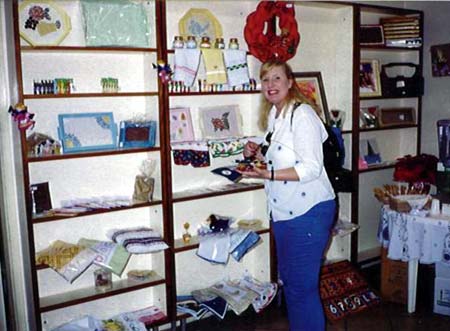
With a variety of crafts lining the shelves, I had my husband translate
as the store vendor explained that the students at Centro de Reabilitacao
Piricicaba made these crafts. Intrigued and wanting to learn more, I paid
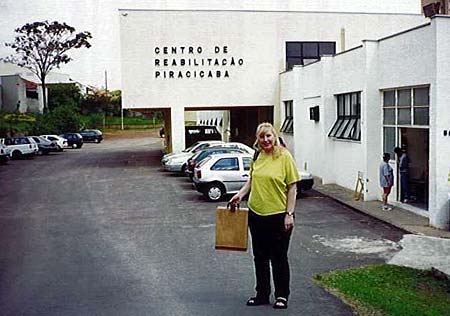
a surprise visit to the local rehabilitation center (Centro de Reabilitacao
Piracicaba). I learned that the rehab center was mainly for children with
disabilities. Each child was classed at a certain level of competence.
Then the children were put to the task of making crafts. Each class performs
work on one aspect of the whole process of completing a project. For those
at the center, craft making is an integral part of the rehabilitative
process.
 D.
D.
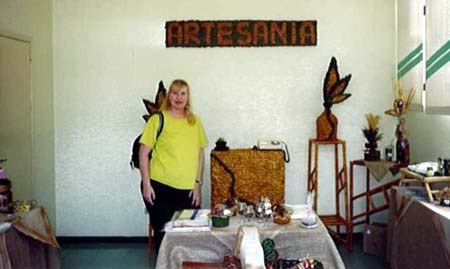
Located adjacent to the center was another retail store showcasing more
crafts for sale. It is here that the rehab students are able to learn
aspects of running a business, customer service, and money handling, in
order to prepare them for work when they leave the center. The project
for these craft sales is called Artesania.
 D.
D.
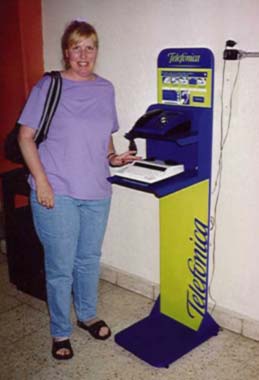
One day, while taking a different entrance into the mall, I happened upon
a stand-alone TTY phone. I was heartened to know that this community was
keeping people with disabilities in the forefront of their minds. Overall,
my observation was that this city operated much like cities and towns
here in the US. Of course, as with any country, there are obstacles yet
to be overcome and a good amount of barriers that still exist, but as
the country continues to grow and work towards a financial and political
independence, it is also considering the needs of individuals with disabilities.
 D.
D.
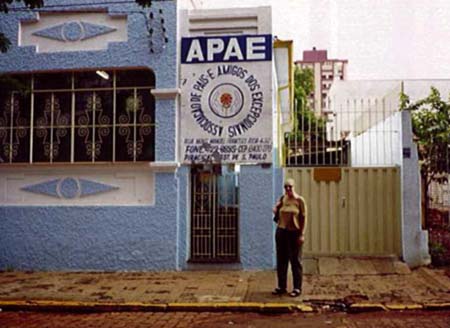
While there, I also paid a visit to the Associacao de Pais E Amigos dos
Excepcionais (Parents and Friends of the Disabled), a center for the deaf
and hard of hearing, or so I was told. It appeared as though the facility
was locked and although I could hear activity inside, no one came to the
door. I was unable to locate a center for the blind but understood there
was a facility in town.
 D.
D.
Though the signs of progress are evident, the one concern voiced to me
while I was there centered on the government's lack of support to older,
disabled citizens. There is virtually no support at all, neither monetary
nor medical. Though the parents of a disabled child receive a small stipend
of support, which ceases when the child becomes an adult, the financial
burden is primarily left to the family and the individual.
Brazil is both a country of progress and turmoil. As many residents struggle
to find ways to support themselves and their families, others struggle
to ensure the indelible rights of those individuals. I believe that through
political and economic stability, Brazil will eventually be able to provide
all its citizens, particularly those with disabilities, with humane and
just opportunities through proper education and rehabilitation.
Editor's Note
An interesting article that relates to a blind woman's experience in Brazil
can be found at the following link:
http://www.miusa.org/general/publications/Stories/decker.html
