
| June, 2002 |
|


Jobs And Disabilities: A Merging Road
In this 21st century, post September 11th economy, one of the biggest
fears that surrounds nearly every individual is the concern that he or
she may lose his/her job. It's hard to estimate just how many people have
directly or indirectly been effected by the declining economy, but undoubtedly
those who had a difficult time finding a job before September 11th will
have an even harder time finding a job now. For many individuals with
disabilities, the stringent job market has only made it more difficult
to find a job. Many employers are looking for the best-qualified, least
expensive employee with the fewest demands on the company. If an individual
with a disability fits the job requirements but requires some assistive
technology devices, the employer would likely choose the prospective employee
that requires the least. This, often times, creates an unfair, disadvantaged
situation for the individual. But with the continual growth and development
of new programs designed to help individuals with disabilities find equal
employment, they could be the largest untapped human resource in the United
States.
By the year 2020, the U.S. labor market will be drastically reduced as
baby boomers leave the workforce while businesses continue to grow. The
current projection for the labor market in 2020 includes 23 million unfilled
jobs. This projection will leave many businesses with two options: export
jobs or import workers. With one of the largest untapped resources in
the United States, the disabled community, this labor market prediction
could be drastically altered if steps are taken now. Many businesses face
challenges when seeking out correct applicants for their positions, including
time, training, and networking. In order to address these issues, organizations
and programs that work with individuals with disabilities to help them
enter or return to the workplace must be able to anticipate the needed
skills and begin training now. For those who are interested in owning
and operating their own businesses, small business and self-employment
services should be able to help individuals with disabilities determine
what the market-needs will be in the future and guide them in creating
business plans and accruing funds.
GCEPD, the Governors Committee on the Employment of People with Disabilities,
a part of the Maryland Governor's Office for Individuals with Disabilities,
has worked diligently to create associations and partnerships with Maryland
businesses to educate them about the disabled community's need for work
and their ability to help fill the needs of many businesses. GCEPD, which
is affiliated with US Department of Labor's Office on Disability Employment
Policy, is comprised of 36 individuals representing state agencies, businesses,
service providers and individuals with disabilities who meet to address
issues related to employment, including attitudinal barriers, healthcare,
architectural accessibility, and transportation. With these issues in
mind, the GCEPD held its annual conference on April 25, 2002. "Maintaining
the Momentum," the name of this year's conference, addressed a variety
of issues, from entrepreneurship and what employers want to maximizing
youth potential and building bridges to businesses.
A number of classes were held for individuals and business owners/representatives
to attend. They addressed issues such as how to start a small business,
how to find employers that will support the needs of employees, and training
employers about the possibilities and benefits of hiring individuals with
disabilities. A panel presentation was held in the afternoon, with representatives
from the ADA resource center, the U.S. Access Board, the EEOC, and the
Maryland Human Relations Commission. The board discussed the various functions
that each department performs and they answered questions from the audience.
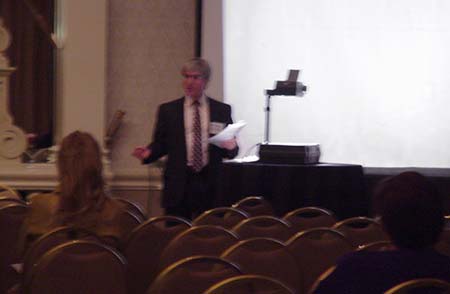 D.
D.
Michael Dalto of the Maryland Technology
Assistance Program presents various issues surrounding in-depth benefits
planning.
GCEPD also held an awards presentation for numerous people in the disability
community. Brian Drnec of Salisbury State University won the Outstanding
Maryland Youth with a Disability Award; Albert Bussone of Pikesville,
Maryland won the Evie Cutler Memorial Helping Hand Award, which is given
to an individual, organization, or agency that does an outstanding job
in facilitating the entry of individuals with disabilities into the workforce;
Wal*Mart Supercenter #2931 of Salisbury, Maryland won the Chester A. Troy
Employer of the Year Award for promoting employment opportunities for
individuals with disabilities; and David Larmore of Salisbury, Maryland
and Joseph I. Cassilly of Bel Air, Maryland both won Outstanding Marylander
with a Disability Award. The awards were given in appreciation of each
of these awardees determination in entering/ re-entering the workplace.
As we move quickly through the beginning of the 21st century, it is important
to encourage the development of communication between those with disabilities
and the businesses that will be relying on them in the near future. With
the forging of the communication and the building of needed skills, a
road can be built between the two communities, each benefiting the other.
