
| June, 2002 |
|


A Voice for the Tech Act Projects
The Sunset for Tech Acts?
There are nearly 50 million individuals in the United States with disabilities.
Of these 50 million, almost all depend or rely on at least some form of
assistive technology to go to school, go to work, participate in their
community, and live independently. Since the beginning of the Tech Act
projects, more individuals with disabilities are able to do this than
ever before.
Though the services and strategies of these Tech Act projects vary from
state to state, each has implemented ways in which to meet the assistive
technology needs of their communities. Through education, trainings, demonstrations,
partnerships, newsletters, and more, each of these projects has made it
possible for individuals to live, work, and learn more independently through
the use of assistive technology.
The Beginning
In 1988, Congress created 10-year state grants programs that would provide
"seed money" for each state to establish a system for improving access
to assistive technology for individuals with disabilities. This act was
amended in 1994, in which the amendment stated that during the final three
years of the programs, federal funding would slowly decrease, and then
end completely at the end of the full ten years. It would then be the
state's responsibility for the continuation of these projects. However,
in 1998, congress extended the funding so that those programs that did
not begin until 1994 would have a full ten years of federal funding.
The Assistive Technology Act of 1998 has allowed every state in the U.S,
plus the District of Columbia, American Samoa, Guam, the Commonwealth
of the Northern Mariana Islands, and the U.S. Virgin Islands to provide
all residents with State Assistive Technology Projects. Each of these
provides information and referral on assistive technology, equipment demonstrations,
trainings, loans, recycling, and buy-out. Currently, these projects are
funded through federal grants from Title I of the Tech Act and are administered
by the National Institute on Disability and Rehabilitation Research (NIDRR)
at the U.S. Department of Education. However, all of this is about to
change.
This year, as the federal funding for these programs comes to an end,
twenty-three states will be eliminated from the original funding. This
will begin the "sunset" of all the state tech act programs. The President's
2003 budget-request supports the ending of the federal funding of these
projects, in order to prevent them from becoming "another never-ending
federal program." The Maryland Technology Assistance Program will be one
of these initial states to be eliminated. Yet, the projected "sunset"
of the TAP programs could be a very shortsighted and potentially harmful
act for individuals with disabilities.
Why we need to stay around
It could be asked why anyone would need a Tech Act program now. Once the
programs have performed their function by informing individuals with disabilities
that assistive technology exists and that they can use it, what more do
they need with their AT program? Some people feel that with the prevalence
of the internet, there is no need to have an AT information and referral
service since all the information that they need about AT products can
be accessed directly from the net and from vendors. This, though, is a
very precarious situation to place ones self in, and particularly those
who are susceptible to being easily lured into buying products out of
an immediate need without further investigation. Not all the information
found on the Internet will be relevant to each individual's needs, nor
will vendors have the individual's specific needs in mind when selling
their products. The AT projects in each state act as a source of information
on various vendors, they educate individuals as to what AT is available,
and they provide individuals with the information needed to make educated
decisions. The termination of the tech act programs would leave an open
gap of susceptibility for individuals who are unsure of the technologies
available and the technologies that would fit their specific needs.
Furthermore, with the development of the internet and the growing changes
and concerns centered around Section 508 of the Rehabilitation Act and
web accessibility, state Tech Act projects are becoming familiar with
the accessibility issues that individuals with disabilities face and the
growing need for an accessible World Wide Web. Many Tech Act projects
are working with various other organizations to educate and train web
developers, educational institutions, and other federally funded institutions
on the necessity of purchasing accessible software and creating accessible
websites. Furthermore, many Tech Act projects are working directly and
indirectly to help develop the guidelines and standards to ensure full
web accessibility in their states.
As technology develops and changes, it is fundamentally necessary for
individuals with disabilities to remain at the forefront of this revolution
demanding equal access during these changes. Without a unified voice to
do this, individuals will quickly find themselves left behind with inadequate
means of accessing information, resulting in fewer job skills and unequal
education. The Tech Act projects of each state have been working diligently
from the beginning of their creation to improve the quality of life for
individuals with disabilities through education and information on assistive
technology.
A voice for the Tech Act Programs?
On March 21, 2002 Paul Rasinski, Executive Director of the Maryland Technology
Assistance Program, along with four other individuals, testified before
the Chairman of the Committee on Education and the Workforce Subcommittee
on 21st Century Competitiveness concerning the importance of the Assistive
Technology Act of 1998.
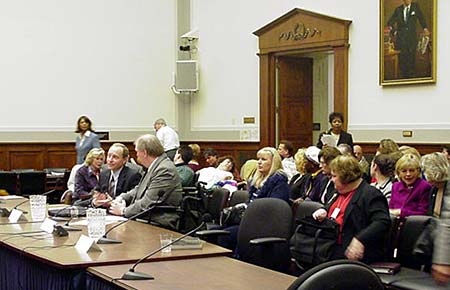
A large number of citizens turned out to show their support and dedication
for the Tech Act projects.
 D.
D.
The crowded hearing room in DC.
Excerpt from Paul Rasinski's Testimony
I think I speak for many of us here today when I say that people with
disabilities are very pleased that you have called this hearing to begin
an examination of this important program that serves so many Americans
with disabilities across the country. It has been almost a decade since
the House of Representatives held a hearing on this law. So much has happened
over that decade, both in terms of the accomplishments of the state grant
programs and in the advances we have seen in technology. Remember that
a decade ago, none of us were using e-mail!
As the information age moves us forward with technological innovations
in our schools, homes and workplaces, and we connect to the " National
Information Infrastructure," it is imperative that all citizens, including
those who are elderly and those with disabilities, be included in every
way. The Federal government has an important continuing role to play in
assuring that this happens. The state grant programs supported by the
Tech Act have created a much-needed infrastructure within the states to
ensure access for people with disabilities. However, the lack of a permanent
federal commitment to a state program undermines this crucial infrastructure
that has leveraged so many additional funds and created so many effective
programs. Without this commitment and the federal leadership, the gains
that have been realized will disappear, as the states are not in a position
to take over the federal role.
Maryland's policies toward electronic information and commerce have placed
it in the forefront of the nation in relation to the technological handling
of business matters. President Bush's New Freedom Initiative is targeted
toward people with disabilities and inclusion of technology into their
lives to enable them to pursue full and active careers with greater independence.
It is the Tech Act projects that co-ordinate initiatives such as these
at the state level, ensuring that people with disabilities are aware of
such initiatives and can benefit from them. The 56 Assistive Technology
Act Programs are an existing infrastructure of consumer responsive projects
that have tremendous capacity to ensure that assistive technology is in
the hands of those who need itÉ.
The information specialists at Tech Act programs have taken years to become
experts and virtual encyclopedias of information about assistive technology
devices and services. Many spend hours each day searching for new information
and building networks of resources to keep up with technological advances.
They share this information regularly with parents, educators, employers,
social workers and others who simply don't have the expertise or time
to search for this information individually.
There is no other law, program, agency or organization that has a mandate
or mission to serve the spectrum of consumers that the Tech Act programs
serve -- all ages and all disabilities. The Rehabilitation Act serves
adults seeking employment; the IDEA serves children in special education
and the Americans with Disabilities Act sets standards for access. Many
diseases and conditions have organizations that assist only those who
have that particular condition. The Tech Act programs have initiated projects
that provide the same level of assistance for infants with birth defects
as they do for elderly individuals with disabilities.
Editor's Note
Paul Rasinski's full testimony can be found at http://edworkforce.house.gov/hearings/107th/21st/assistivetech32102/rasinski.htm
If you would like to show your support or voice your opinion concerning
the prospective sunset of the Tech Act Projects, call or write your local
Washington representatives.
To find and contact your local Maryland congressman, visit the website
http://www.visi.com/juan/congress/cgi-bin/buildpage.cgi?state=md
Or, for more links and information, visit the Maryland Electronic Capitol
at
http://www.mec.state.md.us/
