
| April, 2002 |
|


Mapping Maryland's Access
Maryland residents take their accessibility to resources quite seriously. Without availability of certain programs or the cooperation of various businesses, doing things like pumping gas, using the ATM, or crossing a street in Maryland, could quite possibly be impossible for some. Because of this, we want to take this time to inform our readers about some of the programs and services available to Maryland residents with disabilities. How do these work, you may ask? Well, when someone is ready to cross a street, he/she approaches the corner and listens to the sound of the light. Yes, listen to the sound. If there is traffic moving along the road that the pedestrian needs to cross, the streetlight will make a continual beeping noise. This message alerts someone as to which street is safe to cross. Though a bit difficult to hear against the traffic, it says, "The walk signal is on Taylor Avenue."]
Accessible Gas Pumps
As part of Maryland's dedication in being an accessible state, a volunteer program that promotes accessibility for drivers with disabilities in obtaining fuel from gas pumps has been widely responded to.
Gas stations taking part in this program display an Accessible Gas Pump sign that alerts drivers whose disabilities prevents them from being able to fill their own gas tanks to the gas station accessibility. The station will provide an attendant during the posted hours that will pump gas at the self-service pumps and for self-service prices. However, attendants are not required to pump the gas for the driver if someone able to pump gas is also in the vehicle.
For a more information on this program in Maryland, a listing of all Maryland stations taking part in the program, and maps to these gas stations, please visit the website: www.mdot.state.md.us/ada/index.html
Talking ATM's
Audio assisted or "talking" ATM's have recently become a new addition to many Maryland banks. For those who are blind or vision impaired, this technology will allow new freedom in banking. From the ability to check balances to making deposits, transfers, and withdrawals, representatives of the blind community are excited about this new window of accessibility. The machines will offer audio assistance and instructions for transactions and universal audio jacks for standard headphones so that listeners can hear instructions for transactions privately. There are numerous banks taking part in this new service, including First Union National Bank, Bank of America, and Chevy Chase Bank. Although there is no definitive listing of all the banks and ATM locations that access the new audio technology, please visit the websites of the American Foundation for the Blind at www.afb.org and the National Federation of the Blind at www.nfb.org for more information.
Talking Street Signs and Lights
On the corner of Harford Road and Taylor Avenue in Baltimore County, resides a talking streetlight. It looks no different than any other light, except for at the poles at each corner, two handicapped accessible signs with Braille writing are placed, each pointing across the road. And there, below the signs, are small microphones that alert the blind or visually impaired pedestrian of when to cross the street. 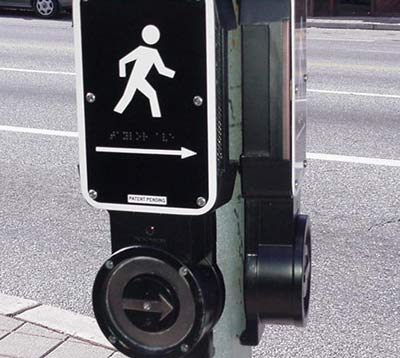 D.
D.
This sign, placed on the corner of Harford Rd. and Taylor Avenue, will alert an individual as to when it is safe to cross the street.
View first movie (mpg format-202kb)...D.
This is the warning sound that the light gives in order to alert the individual that it is not safe to cross.
However, when it is safe, the sign will actually tell the person which street to cross.
The only real complaint I had when using this method of crossing was that the recording was muffled, especially with the loud traffic in the background. However, the talking streetlight technology is both simple and ingenious. Not only will it help those with visual impairments, but it will also help individuals with cognitive and learning disabilities, as well as children and the elderly.
