
| December, 2001 |
|


Voicing Change
Voicing Change: The Hagerstown Public Forum One concern expressed by a number of those family members and staff attending the forum was the fear that the Potomac Center will be closing. Many relatives of individuals residing in the Center turned out to voice their objections to any plans to close Potomac Center while providing comments about the quality of life their relatives are provided at the Center. Another pertinent issue in Hagerstown and the surrounding communities is the low wages paid to Personal Care and direct care Providers and the adverse effects this has on those individuals who rely on care providers. For some of the community, their concern rested in the fact that they could not find individuals who were both qualifies for the particular care they needed and who would work for the low wages being offered. The general wage for caregivers of individuals below fifty-years-old is almost five dollars an hour. Meta Swope, a Personal Care Provider for many years, makes $5.00 an hour and has had to quit providing care for an 87-year-old patient because of the low wages. It was acknowledged that this is an issue across the entire State, and in some respects, even a national problem. For those with developmental disabilities, it was noted that Governor Parris Glendening, working in cooperation with various Legislative Leaders, developed a multi-year strategy to begin addressing this issue. In 2003, $16 million was agreed upon as an initial step to increase the wages of the direct care staff within the developmental disabilities system.
One of the largest issues of the evening, being reiterated during both sessions, was the lack of and need for longer and more in-depth job training for individuals with both physical and cognitive disabilities. Testimony was presented alleging that some businesses in the area are not understanding of the dynamics of the challenges and barriers faced by individuals with disabilities who are seeking work. This was of significance to a number of qualified individuals seeking employment; some spoke of the attitudinal barriers they have encountered in their employment careers. The members of the MACID in attendance assured those in attendance that their comments and testimony would be reviewed and considered as they develop future plans, problem solving efforts and recommendations to the Governor and Legislature. The Hagerstown Public Forum
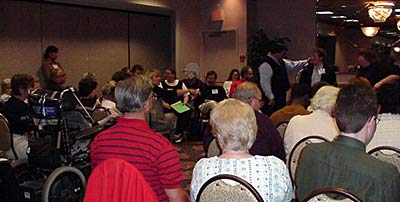
For individuals with disabilities and for the loved ones of individuals with disabilities, concerns about job training, employment opportunities, accessibility, school safety, personal nursing care wages, assistive technology and more, are continually growing in our changing society and economy. Because of this, the Maryland Advisory Council for Individuals with Disabilities (MACID), the advisory council to the Governor's Office for Individuals with Disabilities, held a Public Forum on Wednesday, October 10, 2001, at the Plaza Hotel in Hagerstown. Five Western Maryland counties were included for this forum: Allegany, Garrett, Washington, Frederick and Carroll.
The forum, the second of three to take place in Maryland, was held in two sessions: 3-5 p.m. and 6-8 p.m. With a large turnout for both sessions, a cross-section of the Maryland disability community was represented. From brothers, sisters, and parents of individuals with disabilities, and those with disabilities, to nurses and Personal Care Providers, a range of issues were discussed.
 D.
D.
 D.
D.
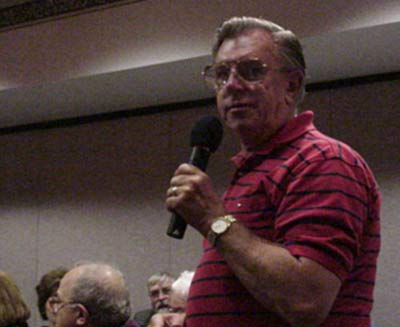
Wayne Taylor, whose daughter resides at the Potomac Center, is one of the many who turned out to object to the possible Potomac Center closing.
 D.
D.
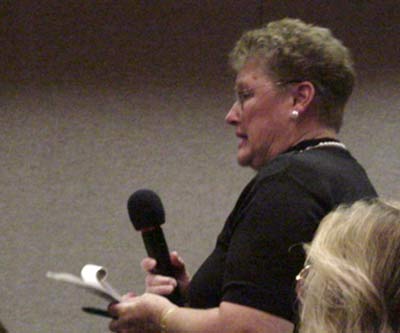
Meta Swope testifies on behalf of increasing the wages for Personal Care Providers
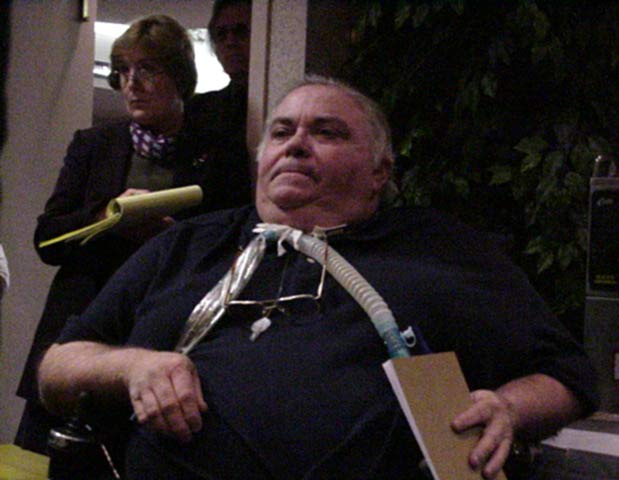
As many other issues were brought to light, such as the need for visual fire alarm aides in public schools, the desire to make Sign Language a foreign language elective in high schools, paratransit needs, and lack of housing for people with developmental disabilities, the committee pooled its knowledge to find resources and solutions to the concerns being voiced. Linn Hendershot, a Hagerstown city councilman who is also disabled, sat in on the forum and urged the audience/public to get city commissioners involved, as well as any other local elected officials. Through this, the public can increase the sensitivity and awareness of disability issues among local politicians.
 D.
D.
Linn Hendershot urges the public to make use of the elected officials in their areas to motivate and demand change.
Hopefully, as a result of these forums, the large turnouts, and the interests, concerns, and suggestions of the public, the forums will prove to be effective in implementing change in Maryland, not only for individuals with disabilities but for those who care for them as well.
