The Helpful House
Japanese Accessible House
By Larry Retzack
It would be our first and, in all probability, last brand new home of
our own. Of course we were excited to be planning the building, especially
those design elements that would be of special benefit to my handicapped
wife, Yasuko.
May 29, 1990--the date of a cataclysmic event that divided our lives
into before and after. I came home from work that day to find Yasuko
in the throes of a stroke. She was lying in bed but couldn't talk and
her right extremities were paralyzed. Vital signs seemed within reasonable
parameters, but she was rushed by ambulance to Sagamihara Central Hospital.
Luckily, the physician on duty that night spoke excellent English. Displaying
the CRI film for my inspection, he pointed to a white circle the size
of a silver dollar in the left hemisphere of Yasuko's brain. "She has
suffered a cerebral hematoma," the doctor explained. "If I can't beta
block it down by morning, we'll have to go in or she won't survive."
The next MRI at eight o'clock the next morning showed the clot had
been reduced to the size of a pea. Yasuko could talk, move her arms
and legs and seemed essentially normal. She was discharged from the
hospital July 4, 1990 and within six months, following a regimen of
physical therapy, was back to about 90% of her pre-stroke condition.
But a numbness and chronic pain in her right foot continued unabated
eventually leading to suicidal depression. We literally went around
the world and spent tens of thousands of dollars to try to stop, or
at the very least ease, Yasuko's pain, all to no avail.
As the years passed, it became increasingly clear that medical science
was unable to lessen the painful numbness, but psychological members
of the medical profession were able to help Yasuko deal more successfully
with the affliction. One psychologist recommended moving Yasuko closer
to her home where she would have daily access to the emotional support
of friends and family. That's when our new house began to take shape.
In 1998, we bought a small corner lot in a new residential area of
southern Fukuoka prefecture. The site was within a 5-minute wheelchair
ride of Yasuko's dearest friend, Rumiko Inaba, and about a 30-minute
cab ride from her Aunt and Uncle Mochizuki, the only family members
that visited Yasuko at Sagamihara Central hospital when she suffered
the stroke.
Land in Japan is extremely expensive. With a population roughly half
that of the U.S. and a habitable area smaller than California, land
is sold not by the acre but by the tsubo, a dimension the size of a
rice straw tatami mat--about 6' x 3'. Our small 75-tsubo lot cost $250,000.
We purchased it from Victoria Homes, the general contractor for our
new house.
Ground was broken in April 1999 with a projected completion date of
that August. Despite the best-laid plans, it wasn't finished until November,
but we took possession on September 22nd. Junichi Koga was Victoria
Homes' original designer.
 D. D.
 D. D.
While very accommodating, some of his initial drawings had us completely
bewildered. One of the first graphics showed the roof rising from either
side as most roofs are wont to do but then stopping well short of meeting
at what would have been a normal apex. The result was a roof with two
normally ascending planes that ended abruptly and were separated by
a U-shaped center section. I mistakenly assumed it was some kind of
drafting convention used when there was insufficient paper to complete
the roof's dimensions.
Since we were living in Okinawa during the construction phase, we
were indeed fortunate to have Rumiko's father, Toshiki Yoshida, a retired
banker, supervising construction of our new house. He meticulously oversaw
virtually every detail including a redesign that produced a roof with
sides that, while of different length and degree of rise, joined at
the top like most do.
One of the most appealing aspects of the new house was Astoria's willingness
to include various features specifically designed to make life easier
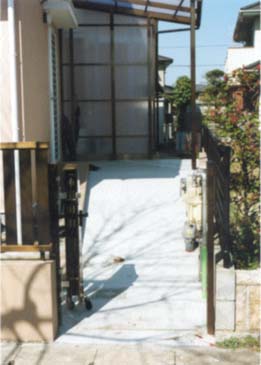
for Yasuko. There are sloping wheelchair ramps of varying height and
length--longer and lower leading to the main front entrance, shorter
and steeper leading to the back kitchen entrance. The former has a parallel
hand bar its entire length that Yasuko may use to help herself along.
The latter leads to a small covered rear porch just the right size for
parking an electric tricycle, which we hope to buy if Yasuko's pain
ever subsides to the point where she can tolerate sitting for extended
periods.
 D. D.
All doors, interior and exterior, are sliding and wide enough to permit
wheelchair passage. Floor joints between rooms have special rails or
covers, depending upon the weight of the door, to facilitate opening
and closing as well as wheelchair access. There are four sinks in the
domicile: kitchen, vanity, laundry room, and toilet. All but the laundry
sink have support bars, which handily double as towel racks.
The Japanese bathtub has standard handles inside the tub for all bathers,
handicapped or otherwise, to ease themselves in and out. Our bathroom
has the added advantage of an additional horizontal wall bar parallel
with the left side of the tub plus a joint horizontal/vertical hand
bar at the rear of the tub. I find the latter particularly helpful when
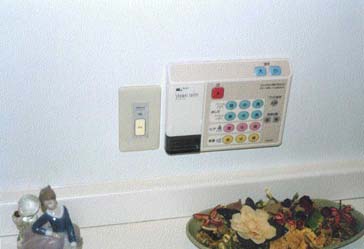
showering. The bathtub has water temperature controls and an alarm button
in case Yasuko needs help.
 D. D.
 D. D.
Unlike most Western residential structures, traditional Japanese homes
almost never have the toilet and bath in the same room. As a child in
Wisconsin the latter configuration never bothered me, but after living
half my life in Japan, my sensibilities have been conditioned to the
point that I would be uncomfortable were that the case. Of course, our
new house has the toilet and bath separate. The toilet has a sturdy
stainless steel handrail to aid in transfer from wheelchair to toilet
seat. Like the bathroom, the toilet has an alarm button, this one adjacent
to the "Shower toilet" controls of water temperature and pressure for
bidet use.
Perhaps the most unique of the technical design aides in our new house
is more to compensate for Yasuko's short height than her handicap. One
of the upper kitchen cabinets boasts a mobile 2-tier shelf attached
to a pivoted, mechanical apparatus. When loaded with at least eight
kilograms of items, the device permits both shelves to be pulled out
and downward, making it easy for her to reach things that would otherwise
require painfully climbing a step stool or using a 3-foot grip extender.
 D. D.
Construction and furniture costs totaled about the same as the lot--around
$250,000 for what, by Western standards, has produced a modest abode.
The last piece of new furniture, a baby grand piano, arrives tomorrow.
We've lived in the new house for just over six months and so far have
experienced few problems. One alteration will be exchanging the exterior
door leading from the laundry room to the deck with that from the kitchen
to the covered back porch. The kitchen door opens counterclockwise,
which means my yard slippers get wet when it rains. Since the deck is
completely covered that's not a problem there. Luckily the deck door
opens clockwise, which I'm hoping, means the back porch roof, with that
door, will keep my slippers dry. Both are frame and door units of precisely
the same size, so I think I can make the switch myself next summer.
Despite the exorbitant costs by American standards, we love our new
home and are very pleased with the features designed to help Yasuko
accommodate her chronic pain.
|


