 |
July 1997 |
 |
|
 |
|
|
|
July 1997 |
| |
|
|
|
|
Paper-Based Technology Comes Of Age In Africa
By Torn Kerr
OT Advance Assistant Editor
ADVANCE for Occupational Therapists
Outdated calendars, junk mail, old newspapers, and last year's greeting cards have no value to most people. But to Zimbabwean Bevill Packer, the "throw away" paper products are a gold mine in disguise.
Packer was into "recycling" before it was "cool" to do so. He uses old paper to make wheelchairs and other assistive devices.
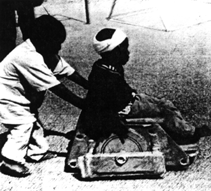
Although this child is getting a hand from a friend, this APT aid is designed for self mobility. (photo/courtesy Bevill Packer)
Not possible you say? Well, spend a few minutes with Packer and he'll convince you that almost anything can be created with paper, through what he calls Appropriate Paper Based Technology (APT). To understand APT, one needs to know its bizarre origins. A sociology professor in a Zimbabwean college, Packer developed APT when he was asked to take over art classes there to help fill the shortage of teachers during the independence struggle between 1977 and 1981.
"In those days there were no paints, brushes and paper for doing art in the schools," Packer recently told ADVANCE from his home in Harare, Zimbabwe. "These students would be sent to schools that could not afford to buy these things. to, we began to work on ways of teaching art without buying materials."
This arduous task, which Packer's students called "art that costs nothing" (clay, grasses, leaves, reeds and waste paper/cards) became the foundation for APT (pronounced "apt"). Unfortunately, when the students graduated and became teachers in Zimbabwe School Systems, they were faced with large numbers of students and class durations too short (about 30 minutes) to teach the technology.
When Packer and his wife retired in 1982, the couple decided to take it upon themselves to popularize APT and explore the possibilities of the technology as a productive adult activity. They established four ground rules to add more credibility to their practice. To be recognized as APT, a product must be strong, useful, attractive and made from materials that cost nothing.
Throughout the 1980s, the Packers conducted several experiments with APT and began to share the technology with local groups and organizations. These "students" began to teach others about APT throughout the country, and courses were scheduled outside Zimbabwe's borders to include people from Mauritius, Zambia, Botswana and Lesotho.
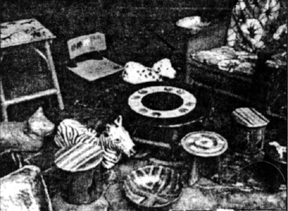
Articles decorated entirely with earth paints used In different ways: direct painting, stencils; paper cutouts, paper strips, mosaic pieces. (photos/ courtesy BeviI Packer)
During this time, a variety of useful articles for the home such as toys, furniture for the pre-school as well as wheelchairs for two severely disabled students were created.
Soon the technology was demonstrated in international exhibitions and started to gain acclaim in Western civilizations. According to Packer, most people are surprised by the strength of the product.
"They are astonished," he said. "These articles wear extremely well. As long as the material is protected from rain or water, the material is very durable and can last for years. The secret behind the toughness of APT products is that paper, of course, is actually wood.
"A sheet of paper, considering its thinness, is strong," he says. "By pressing pasted sheets of paper together and drying them we are, in a way, reconstituting wood. The difference is APT `wood' will not crack, and if carefully made, will not come apart."
In Zimbabwe, Packer often uses newsprint, computer paper, cementbag paper and thin and thick cards for construction of his products. The paste that holds the paper together is also "homemade," readily available and inexpensive. In APT, the only adhesive used is created from some kind of flour. According to Packer, when the paste is made well, it is very strong and sticks well to paper and card because it penetrates both surfaces and bonds them together tightly. Wet flour paste also softens the pieces so they can be crushed, rolled, bent and molded to lie flat to create a good fit, It is also a clean adhesive that does not harm the hands and can he easily washed off.
Because there are so many useful products that can be made through APT, Packer says that it cannot be described as an art form. "APT is not a craft for making a certain range of articles," Packer writes in his book Appropriate Paper-Based Technology (APT): A Manual (1995, Intermediate Technology Publications Ltd., 103405 Southampton Row, London, WCIB 4HH, UK, tel. 144.10.171. 436-9761). "It is a body of knowledge, techniques and devices which can be used to construct products as diverse as dolls and solar cookers, armchairs, early learning apparatus. baskets and wheelchairs for the disabled."
Packer takes his science seriously, reminding "Apters" (Packer's word for people who use APT) that products that don't follow the rules of APT can be harmful, especially when the product is a piece of furniture or an assistive device, To be considered an APT article. the product must be developed in four stages:
- It must be built by layering pasted strips of paper and allowing it to dry.
- It must be strengthened and tidied, which includes cutting or rubbing smooth any uneven edges and binding them neatly, bandaging all joins with strong paper and giving the product a smooth, tidy appearance.
- It must be decorated in a variety of ways, which include wetting the surface of an article with paste and letting it dry completely.
- It must be finished with an application of varnish to strengthen and protect all surfaces of the article and allowing it to dry.
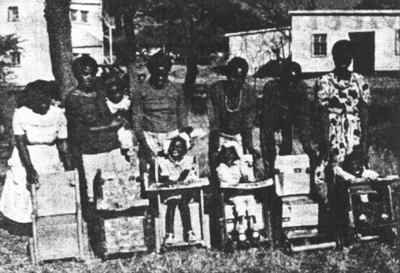
A group of Zimbabwean mothers who made wheelchairs for their disabled children display their products.
Because drying alone can take up to a week, Packer says that it really takes more than a day to create a good APT article, By following these rules, an Apter can construct almost anything. "You can create chairs, footrests tables and bar stools." he said. "ln fact, a group in Zambia makes coffins using APT." Other products of APT were developed because of a lack of resources in rural sections of Zimbabwe. In one hospital, Packer instructed mothers of children with disabilities how to make chairs and other assistive devices for their children. "The mothers each made a wheelchair for their disabled child," he said. "to when they went back, they could teach others how to make them." APT wheelchairs include a backing with a front board and a tray. But what is most remarkable is that the wheels of the chair are also made of paper. Thin "card," ranging from 5 to 20 mm. in thickness, is used for construction of the wheels. The paper is rubbed down to remove all the edges and make the surface smooth and round. The wheels are then bound with several layers of strong paper. Axles and bearings also use thin card and are formed into a very tight roll. Wrapping layers of thin plastic on a roller strengthens the axle, and the bearing is then rolled on the fattened axle for testing. The axle is then taken off the bearing and both are dried completely. After drying, the bearing and axle are tested again. When this is completed and all parts are dry, the wheel is ready for assembly.
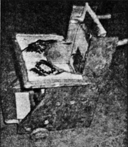
This wheelchair, complete with tray and footrests. was made at an APT course in Kenya. (photo/courtesy Bevill Packer)
While the chair is not as maneuverable as a standard wheelchair, Packer says it serves its purpose. "It is not for long distances because the wheels are also carved very thick," he said. "But the chairs are very sturdy, and a child usually has no problem getting around in them." Aside from the adaptive devices it produces. Packer says, APT itself is very therapeutic and has been used as a purposeful activity for people with mental retardation and mental illness.
"Molding mash, like molding clay, can be very relaxing...he writes. "It stimulates creativity. Molding paper presents more of a challenge and is suitable for more confident patients." Packer says that some other health care professionals are preparing to use APT to illustrate the birth process. including possible complications and aftercare.
"From an original and carefully constructed set of models, comprising the pelvis, foetus and breast, molds have been made to enable midwives to make their own accurate set of models using papier mache or paper layers," he wrote. "If successful, this system could be used to make a variety of teaching aids where accuracy of detail is essential."
Packer presented at the WFOT Congress in London a few years ago. "Universities are beginning to use APT, and OTs seem to be one of the professions who enjoy using the technology," the African educator said. "Hopefully, more OTs will publish their successes with APT in rehabilitation journals around the world." Packer believes that it is important that Apters develop a world-wide network to discuss the technology and help spread the message of its usefulness.
"There have been efforts to form an organization but nothing really has really taken root," he said. "I think its important that these people get together to share their problems and successes and share APT with the rest of the world."
Readers interested in contacting Bevill Packer may write to him at:
1 Mullerry Close
Highlands
Harare, Zimbabwe
Reprinted from: ADVANCE for Occupational Therapists * March 31 1997
 Home |
 Newsletter |
 Calendar |
 Previous |
 Index |
 Next |
 Contact |