 |
December 1995 |
 |
|
 |
|
|
|
December 1995 |
| |
|
|
|
|
Assistive Technology can be an equalizer for people with disabilities. In education, assistive technology has facilitated mainstreaming, inclusion, and opportunities for children with disabilities to take part in academically challenging environments. As a society, we are leaning that having a disability does not preclude an ability to learn, but may require modifications to assist with the learning process. During the past decade or more, the focus has been on developing assistive technology. In the future, the focus will encompass more of the applications for the technology under development, including curriculum adaptations.
We at IntelliTools are committed to providing tools which make it as easy as possible for children with disabilities to take an active role in academically challenging environments. We have developed a set of tools for adapting computer technology to be accessible for people with disabilities. Our vision of the future includes adapted academic curricula which makes it easy for school teachers to include children with disabilities in rigorous academic environments.
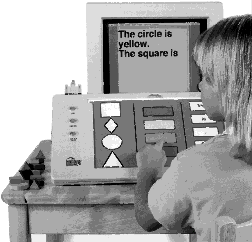
Without basic reading, writing and math skills, it is very difficult to maintain employment and self care in today's society. Math and literacy are noted as two areas where children with disabilities have a great deal of difficulty in gaining skills. The Center for Literacy and Disability Studies at the University of North Carolina at Chapel Hill note in their literature that most children with developmental disabilities experience significant difficulties learning to read and write. Likewise, Adaptive Technology Specialist, Florence Taber-Brown, Ed.D., has been noted to say, "Students with physical disabilities have unique problems in the area of math. These issues need to be addressed." With the assistance of grants from the National Science Foundation (NSF) and the National Institutes of Health (NIH), the staff of IntelliTools are developing products to address these challenging academic needs.
Curriculum adaptations are being developed for the IntelliTools' platform of products. The current product line includes: IntelliKeys(r), an alternative computer keyboard for special needs and education for the Apple, Macintosh or PC compatible computer platforms; IntelliKeys Overlay Maker(r), a drawing program that allows users to customize overlays for use with IntelliKeys; IntelliTalk(r), a simple talking word processor for the Apple II, Macintosh and PC Compatible computers; IntelliPics(tm), a multimedia Macintosh product designed to enhance learning exploration; and ClickIt!(tm), a powerful utility program that allows you to pinpoint "hot spots" on the screen and assign keystrokes to those spots so users can point and click without a mouse.
The IntelliTools platform of products were used in developing adapted curricula for language arts in a recently completed Small Business Innovation Research (SBIR) grant project funded by the NIH titled Language Arts Keyboard Overlays for Disabled Students. Some of the findings from this project include:
The final report has been published and is available upon request. For a copy, call IntelliTools and ask for: Phase I Report: Language Arts Overlays for Students with Disabilities.
Products resulting from the Phase I Language Arts Project include an innovative technique for using a series of overlays to sequentially build writing skills which will be commercially available in the spring of 1996, and a workshop presentation series on how to incorporate IntelliTools technology into a daily school curriculum.
IntelliTools has also been funded by the National Science Foundation to develop adapted mathematics materials under two projects, an SBIR and a Development Grant, both titled Multi-Math Adaptations, which commenced in July 1995 and September 1995, respectively. The goal of these projects is to bridge the gap between math education and teaching math skills to children with disabilities. Under these projects, IntelliTools is developing adapted K-6 math materials to use with standard math curricula. We are working with leading math curriculum developers, and benefiting from the cooperation of prominent math publishers. Our adapted math materials will be developed in California, and evaluated at five national trials sites. Developmental product testing will begin in December 1995.
With curriculum adaptations for assistive technology, we anticipate that inclusion and mainstreaming will be easier for all. As a result, children with disabilities should have greater opportunities to be a part of academically demanding classroom environments. In this article we have talked only about the IntelliTools product line as these are the products that we are most qualified to speak on. However, assistive technology which facilitates academic participation is increasingly prevalent in the field. In the future, we imagine that individual potential will be more accurately realized as a result of these technologies currently under development.
 |
 |
 |
 |
 |
 |
 |
| |
|
|
|
|
|
|