 |
December 1995 |
 |
|
 |
|
|
|
December 1995 |
| |
|
|
|
|
The field of assistive technology (AT) is a broad and interconnected one, indeed. Communication aids, mobility aids, sensory aids, orthotics, prosthetics, writing aids, eating aids, and page turners exist in a broad spectrum of technology people with disabilities use to enhance their lives. The future of such a broad field can perhaps best be glimpsed by viewing the history of one of its many divisions.
People have been using AT since the beginning of recorded history. There are hieroglyphic representations of canes. Because of its recent and rather rapid development during the past 30 years, augmentative communication (AAC) can serve as an interesting lens through which to view AT in general.
The first phase of an AT addresses a widely perceived need just as wheelchairs addressed the needs of western society after the Napoleanic, Crimean, and U.S. Civil Wars.
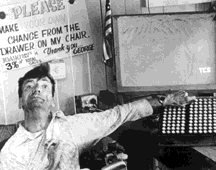 The modern era in AAC began in the 1960's when many clinicians recognized that traditional articulation therapy was not going to prove a powerful tool in helping people with significant speech and motor disabilities to communicate. People began exploring the use of language boards for people who were physically or cognitively unable to use speech or traditional handsigns.
Although no one sphere of activity operates in isolation, the 1970's in AAC was an era dominated by the efforts of engineers, occupational therapists, and others to assist individuals with issues of physical access. Headsticks, switches, scanning systems, and eye-gaze techniques were developed and became widely available.
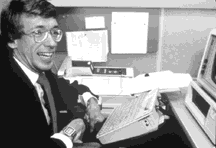 The 1980's seemed to center around language. The four language representation techniques most commonly used today: levels/pages, abbreviation expansion, word prediction, and semantic compaction were given form and became widespread.
Today, in the 1990's, in the presence of good clinical and educational practice, proper evaluation, training and support, many people with significant speech and physical impairments can develop or be restored to personally satisfying levels of communication.
What then is the future in AAC? Exotic and fabulous new technologies? Mind-body links which can generate speech accurately reflecting neurolinguistic cyberstates? Virtual communication! Well, perhaps. Advances will certainly be made in the area of access, in the areas of artificial language generation, voice technology, weight, durability, and size of equipment.
But, the real challenge in AAC, and across the board in AT, is not the development of exotic new technologies, it is, first, in the purchase, then in the implementation, and finally in the support of the often superb technologies currently available.
I have purposefully divided the challenge into three parts. The first of these is purchase. It is axiomatic to say that the promise of technology is unfulfilled if the technology is unavailable. People with disabilities and their advocates often have to fight long, energy-consuming, frequently desperate battles to acquire appropriate technology. Some divisions of AT are better funded than others, but almost all are thinly funded in relationship to real needs.
The promise of technology is also unfulfilled if the appropriate AT is not well implemented. Legendary accounts exist of the arrival by mail at a group residence of expensive, complex assistive technology with no funded implementation strategy. Often people with significant speech and multiple impairments are given only the most cursory training in the operation of an AAC system.
Society thinks it appropriate to devote 90 to 180 hours to train a typically-developed adolescent in touch typing, yet our system blanches at funding that much training to help an individual overcome mountainous linguistic and physical challenges to achieve fluent augmented speech.
The promise of technology is unfulfilled if the appropriate AT is not consistently supported. A power chair that breaks down and is not repaired for two months is not fulfilling the promise of independent mobility. A page turner that is not regularly set up by care staff is a page turner which turns no pages. An AAC system which is not charged and appropriately mounted assists little in conversation.
Purchase, implementation, and support are the keys to good outcomes not only in the present but in the future of AT. Technology will improve, and in fact, become easier to purchase, implement, and support, but reflecting human activities like speech and language outside the human body will always remain challenging and require substantial human investment.
 Bruce Baker is a classically trained linguist. He has worked in artificial intelligence for Westinghouse and currently serves as adjunct associate professor at the University of Pittsburgh; consulting linguist to the Prentke Romich Company and President of Semantic Compaction Systems, a Pittsburgh software publishing house.
 |
 |
 |
 |
 |
 |
 |
| |
|
|
|
|
|
|