

|
| "Jim Crow" laws barred African Americans from access to employment and to public places such as restaurants, hotels, and other facilities. In the South especially, Blacks lived in fear of racially motivated violence. |
|
| Halifax, North Carolina, April 1938. Library of Congress, Washington, DC |
|
|
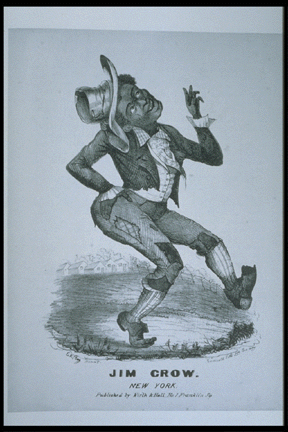 The minstrel show is one of
the first indigenous forms of American entertainment. The tradition began
in February 1843 when a group of four white men from Virginia, billed as
the "Virgina Minstrels", applied black cork to their faces and performed
a song-and-dance act in a small hall in New York City. The performance
was such a success that the group was invited to tour to other cities and
imitators sprang up immediately. These troups were successors to individual
performers who imitated Negro singing and dancing. One of the earliest
and most successful is the performer pictured here: Thomas Dartmouth "Daddy"
Rice. Rice, a white actor, was inspired by an elderly Negro in Louisville,
Kentucky crooning and dancing to a song that ended with the same chorus:
"Weel about and turn about and do jis so, Eb'ry time I weel about I jump
Jim Crow." Rice's imitation of the Negro's song and dance routine was an
astounding success that took him from Louisville to Cincinnati to Pittsburgh
to Philadelphia and finally to New York City in 1832. He then performed
to acclaim in London and Dublin, where the Irish in particular appreciated
his blackface song-and-dance routine of "Jim Crow."
The minstrel show is one of
the first indigenous forms of American entertainment. The tradition began
in February 1843 when a group of four white men from Virginia, billed as
the "Virgina Minstrels", applied black cork to their faces and performed
a song-and-dance act in a small hall in New York City. The performance
was such a success that the group was invited to tour to other cities and
imitators sprang up immediately. These troups were successors to individual
performers who imitated Negro singing and dancing. One of the earliest
and most successful is the performer pictured here: Thomas Dartmouth "Daddy"
Rice. Rice, a white actor, was inspired by an elderly Negro in Louisville,
Kentucky crooning and dancing to a song that ended with the same chorus:
"Weel about and turn about and do jis so, Eb'ry time I weel about I jump
Jim Crow." Rice's imitation of the Negro's song and dance routine was an
astounding success that took him from Louisville to Cincinnati to Pittsburgh
to Philadelphia and finally to New York City in 1832. He then performed
to acclaim in London and Dublin, where the Irish in particular appreciated
his blackface song-and-dance routine of "Jim Crow."